Did you know that there's a site where you can make free flashcards for any vocabulary words you might need to learn? Visit http://teacher.scholastic.com/tools/flashcards.htm and click on the oval that says "Words." You can then make as many flashcards as you want where the word is on the front & the definition is on the back.
How neat is that?!
Tuesday, June 30, 2009

Saturday, June 27, 2009
June Blogging - What did you like best?
Can you believe that the month of June is almost over? I can't!
We've had 20 blog posts (including this one). Which one (or ones) did you enjoy most? Was there a particular post or theme that you found to be helpful? What would you like to see more of in the future?
Let me know!
:-)
We've had 20 blog posts (including this one). Which one (or ones) did you enjoy most? Was there a particular post or theme that you found to be helpful? What would you like to see more of in the future?
Let me know!
:-)
Friday, June 26, 2009
Vocabulary Extravaganza (Part 5)
Today concludes the week of vocabulary from Dictionary.com, and I hope you've enjoyed this series. This last topic will focus on April 2002. Do you want to know why I selected that particular month & year? That's when GED Online was launched in Broward County! Hooray!
Check out some words from April 2002. This time, I won't tell you how many you have to post. You can pick what you'd like to do & share with us! Maybe you want to review all of the words, but only post 1 of them. That's fine! Maybe you'd rather share with us the words from your favorite numbers. It's up to you! Feel free to post as many words & definitions as you'd like!!
April 2002 - Words of the Day
Check out some words from April 2002. This time, I won't tell you how many you have to post. You can pick what you'd like to do & share with us! Maybe you want to review all of the words, but only post 1 of them. That's fine! Maybe you'd rather share with us the words from your favorite numbers. It's up to you! Feel free to post as many words & definitions as you'd like!!
April 2002 - Words of the Day
Thursday, June 25, 2009
Vocabulary Extravaganza (Part 4)
The vocabulary extravaganza is almost over! Let's take our fourth dive into some past words of the day from the Dictionary.com website.
Check out these words from May 2000. Please pick 4 of them that you did not know (or didn't know that well). Post the words & their definitions.
May 2000 - Words of the Day
Check out these words from May 2000. Please pick 4 of them that you did not know (or didn't know that well). Post the words & their definitions.
May 2000 - Words of the Day
Wednesday, June 24, 2009
Vocabulary Extravaganza (Part 3)
We're halfway through our expedition on vocabulary! How many new words have you learned so far? I bet it's a bunch!
Let's explore the words highlighted during January of 2000. In fact, I'm going to pick one to do with all of you since this is a word you often hear, but when you see it, you wouldn't think it's the same word!
segue \SEG-way\ , intransitive verb:
1. To proceed without interruption; to make a smooth transition.
Sample sentence: The newscaster made a great segue from the story about restaurants to a story about nutrition.
Please use the link below, take a look at the words from January 2000, and pick 4 (not 3 like the previous blog topics). Come back here & post your words with definitions. Want an extra challenge? Try correctly using 1 or more of them in an original sentence! :-)
January 2000 - Words of the Day
Let's explore the words highlighted during January of 2000. In fact, I'm going to pick one to do with all of you since this is a word you often hear, but when you see it, you wouldn't think it's the same word!
segue \SEG-way\ , intransitive verb:
1. To proceed without interruption; to make a smooth transition.
Sample sentence: The newscaster made a great segue from the story about restaurants to a story about nutrition.
Please use the link below, take a look at the words from January 2000, and pick 4 (not 3 like the previous blog topics). Come back here & post your words with definitions. Want an extra challenge? Try correctly using 1 or more of them in an original sentence! :-)
January 2000 - Words of the Day
Tuesday, June 23, 2009
Vocabulary Extravaganza (Part 2)
Here's part 2 of our week-long look at vocabulary from the Dictionary.com site. This time, you'll be visiting the archive of the September 1999 words of the day. Just like yesterday's blog topic, please select 3 words that you were not familiar with before visiting the site, come back here, and post those words with definitions. Be sure to visit this blog topic often so you can see what words get added after you post!
September 1999 - Words of the Day
September 1999 - Words of the Day
Monday, June 22, 2009
Vocabulary Extravaganza (Part 1)
Vocabulary is such an important part of writing. Without words, where would we be with writing? I guess you could say that we'd be nowhere because you can't write without words! So in the spirit of that, this week will be a vocabulary extravaganza!!
One of my favorite sites is Dictionary.com because there are just so many neat resources there, such as a dictionary, thesaurus, word games, and more! But the best part is the "word of the day" archives! Every word of the day that they've had since May 3, 1999 is available!
Please take a look at the words highlighted during May 1999. Pick 3 words that you did not know prior to visiting that site. Then come back here, post each word, and its definition!
May 1999 - Words of the Day
One of my favorite sites is Dictionary.com because there are just so many neat resources there, such as a dictionary, thesaurus, word games, and more! But the best part is the "word of the day" archives! Every word of the day that they've had since May 3, 1999 is available!
Please take a look at the words highlighted during May 1999. Pick 3 words that you did not know prior to visiting that site. Then come back here, post each word, and its definition!
May 1999 - Words of the Day
Sunday, June 21, 2009
Writing as a Memory Tool (Part 6)
Here's the fifth & final note-taking tip!
Review and edit your notes.
"Ideas won't keep; something must be done about them." - Alfred North Whitehead (1861 - 1947), English mathematician and philosopher
Academic skills centers and other authorities on effective study skills consider reviewing and editing class notes to be the most important part of note-taking and essential to increasing learning capacity.
- It is extremely important to review your notes within 24 hours.
- Edit for words and phrases that are illegible or don't make sense. Write out abbreviated words that might be unclear later.
- Edit with a different colored pen to distinguish between what you wrote in class and what you filled in later.
- Fill in key words and questions in the left-hand column.
- Note anything you don't understand by underlining or highlighting to remind you to ask the instructor.
- Compare your notes with the textbook reading and fill in important details in the blank spaces you left.
- Consider rewriting or typing up your notes. (Ellis).
Note: For additional techniques for study and exam preparation, go to Tips for Effective Study at http://www.cod.edu/people/faculty/fancher/STUDY.HTM
-----
This final blog post on this topic may be the most important of them all! As I've stressed to students during Elluminate sessions, notes are no good if you take them and don't look at them after the session is done! If you put them in a folder, lay them on a table, or file them away, you're giving up the chance to look over your notes & to help that information stick in your brain!
Now that you've had a chance to see all 5 note-taking tip blogs, what have you learned that you'll start doing or do more often?
Saturday, June 20, 2009
Writing as a Memory Tool (Part 5)
Here's our fourth note-taking tip!
For that fourth bullet point above, online students should add something about material written in their online courses, and especially Elluminate sessions!
Which one of the above items is most important to you? Why?
Play close attention to content.
"There is a great difference between knowing a thing and understanding it." - Charles Kettering (1876 - 1958), American electrical engineer and inventor
Knowing what and how much to write down is sometimes difficult. Rely on some of the following tips for what to include in your notes.
- Details, facts, or explanations that expand or explain the main points that are mentioned. Don't forget examples.
- Definitions, word-for-word.
- Enumerations or lists of things that are discussed.
- Material written on the chalkboard or on a transparency, including drawings or charts.
- Information that is repeated or spelled out. (University of Texas at Austin)
For that fourth bullet point above, online students should add something about material written in their online courses, and especially Elluminate sessions!
Which one of the above items is most important to you? Why?
Friday, June 19, 2009
Writing as a Memory Tool (Part 4)
Here's the third tip to help make you a good note-taker!
Develop a note-taking method that works for you. (There are many methods out there; it's not a "one-size-fits-all" strategy. Find one that you can do & one that will help you remember the things you're hearing & seeing.)
Which one (or ones) of these do you think is the most useful? Why did you pick that one (or those ones)?
Develop a note-taking method that works for you. (There are many methods out there; it's not a "one-size-fits-all" strategy. Find one that you can do & one that will help you remember the things you're hearing & seeing.)
"Learn, compare, collect the facts." - Ivan Petrovic Pavlov (1849 - 1936), Russian physiologist.
Fine-tune the structure and organization of your notes to increase your notetaking speed and comprehension later.
- Start each new lecture on a new page, and date and number each page. The sequence of material is important.
- Write on one side of the paper only. You can set them out side-by-side for easier reviewing when studying for an exam.
- Leave blank spaces. This allows you to add comments or note questions later.
- Make your notes as brief as possible. "Never use a sentence when you can use a phrase, or a phrase when you can use a word" (Berkeley).
- Develop a system of abbreviations and symbols you can use wherever possible.
- Note all unfamiliar vocabulary or concepts you don't understand. This reminds you to look them up later.
- For examples of popular note-taking formats, see Note-taking Systems at http://www.sas.calpoly.edu/asc/ssl/notetaking.systems.html
Which one (or ones) of these do you think is the most useful? Why did you pick that one (or those ones)?
Thursday, June 18, 2009
Writing as a Memory Tool (Part 3)
Here's the second tip to help you improve your note-taking skills.
Improve your listening skills. (This is especially important for those who take an online course, as many times, you are not seeing your teacher in-person, but rather hearing him or her on the phone or in an Elluminate session!)
Please note that even though most of us aren't sitting in on a true "lecture" style class, any presentation or discussion can have these tips applied! :)
What do you think?
Improve your listening skills. (This is especially important for those who take an online course, as many times, you are not seeing your teacher in-person, but rather hearing him or her on the phone or in an Elluminate session!)
"Learn how to listen and you will prosper even from those who talk badly." -- Plutarch (A.D. 46 - 120). Greek biographer and philosopher
- Start by entering the classroom with a positive attitude. Going to class thinking, "This is the last place I want to be today" only sets the stage for inattentive listening. Approaching lectures with a positive attitude allows one to be open-minded and enables you to get the most out of the information presented.
- Make a conscious effort to pay attention. Concentrate on concentrating. "Without concentration there is no focus, and without focus there is no learning" (Pauk 190).
- Adapt to whatever direction a lecture takes. When a lecture takes an unexpected detour, say a student asks a question you aren't particularly interested in, students have a tendency to "zone out." Before you know it, the lecture got back on track five minutes ago, and you missed crucial information that should have been noted.
Please note that even though most of us aren't sitting in on a true "lecture" style class, any presentation or discussion can have these tips applied! :)
What do you think?
Wednesday, June 17, 2009
Writing as a Memory Tool (Part 2)
We're going to examine 5 tips so you can be an effective note-taker. These all come from http://jerz.setonhill.edu/writing/academic/notes-tips.htm, and even though they focus on traditional classroom-based, we'll talk about how they can be modified for online classes!
Go to class prepared. (This is true no matter if it's an online class or an "in-person" one!)
What do you think about these first few suggestions? They make sense, don't they? Do you do those things? If not, do you think you might start doing them?
Go to class prepared. (This is true no matter if it's an online class or an "in-person" one!)
"Always have a plan and believe in it. Nothing good happens by accident." -- Chuck Knox, NFL football coach
- Use a three-ring binder instead of a spiral or bound book. Pages can be easily removed for reviewing. Handouts can be inserted into your notes for cross-referencing. You can insert your own out-of-class notes in the correct order (Ellis).
- Bring highlighters to class. Instructors will frequently make comments like, "This is an important concept." Or, "Make sure you understand this." These are direct clues that this will more than likely be on an exam. Highlighting these notes will help remind you later that this is definitely something you need to know.
- Read assigned material and previous class notes before class. Make notations about material or concepts you don't understand. Look up vocabulary words that are unfamiliar to you. You will have a better understanding about what the instructor is lecturing about and that will allow you to better decipher the more important points of the lecture.
What do you think about these first few suggestions? They make sense, don't they? Do you do those things? If not, do you think you might start doing them?
Tuesday, June 16, 2009
Writing as a Memory Tool
Have you ever considered that writing can be a tool that helps you remember things better? That's not really a surprise to many of us, especially since so much emphasis is placed on taking notes or writing other important things down! Here's an interesting fact that I came across today!
Few people realize how fast memory fades. Studies on memory have shown that, without review, 47% of what a person has just learned is forgotten in the first twenty minutes and 62% is forgotten after the first day. (University of Texas at Austin).
(From http://jerz.setonhill.edu/writing/academic/notes-tips.htm)
Isn't that amazing, but also kind of scary?!
Our next set of blog topics will focus on how to be a better note-taker! So, let's do a little opening activity right now! How, why, or when do you take notes? Once you take them, what do you do with them? Share your opinions with us!
Few people realize how fast memory fades. Studies on memory have shown that, without review, 47% of what a person has just learned is forgotten in the first twenty minutes and 62% is forgotten after the first day. (University of Texas at Austin).
(From http://jerz.setonhill.edu/writing/academic/notes-tips.htm)
Isn't that amazing, but also kind of scary?!
Our next set of blog topics will focus on how to be a better note-taker! So, let's do a little opening activity right now! How, why, or when do you take notes? Once you take them, what do you do with them? Share your opinions with us!
Monday, June 15, 2009
Writing - More Blogs!
As we've talked about in the past, an important part of being a good writer is being a good reader. No matter what you choose, you should be reading something every single day! There are some enjoyable blogs out there that you might want to visit! (For the entire list that was on the Sun Sentinel website, click here.)
Worst Pizza : http://www.worstpizza.com/
Jazz & Blues : http://jazz-bluesflorida.blogspot.com/
Human Resources & Employment : http://www.hrbartender.com/
Pets : http://www.southfloridapets.blogspot.com/
Try visiting one or two, read a bit, and then come back to tell us what you went to & what you thought of it!
Worst Pizza : http://www.worstpizza.com/
Jazz & Blues : http://jazz-bluesflorida.blogspot.com/
Human Resources & Employment : http://www.hrbartender.com/
Pets : http://www.southfloridapets.blogspot.com/
Try visiting one or two, read a bit, and then come back to tell us what you went to & what you thought of it!
Sunday, June 14, 2009
Vocabulary - Resume Terms
Have you ever wondered if there's specific vocabulary that you'd use on a resume? Well, the answer is "yes." Take a look at this neat site that I found that does just that! http://esl.about.com/od/businessspeakingskills/a/j_vocabulary.htm
The first part of that site lists verbs that will help you express just exactly what you did with impressive vocabulary. These verbs are used to express responsibilities and tasks performed. Please look at the list below & identify 2-3 words that you'd like to look up so you can understand the meaning a bit better. Then, visit an online dictionary (like http://www.merriam-webster.com/), look up the word, and come back here to post each word with its definition!
accomplished
acted
adapted
administered
advanced
advised
allocated
analyzed
applied
approved
arbitrated
arranged
assisted
attained
blended
brought
built
carried out
catalogued
changed
classified
collaborated
compared
completed
computed
conceived
conducted
constructed
consulted
contracted
controlled
The first part of that site lists verbs that will help you express just exactly what you did with impressive vocabulary. These verbs are used to express responsibilities and tasks performed. Please look at the list below & identify 2-3 words that you'd like to look up so you can understand the meaning a bit better. Then, visit an online dictionary (like http://www.merriam-webster.com/), look up the word, and come back here to post each word with its definition!
accomplished
acted
adapted
administered
advanced
advised
allocated
analyzed
applied
approved
arbitrated
arranged
assisted
attained
blended
brought
built
carried out
catalogued
changed
classified
collaborated
compared
completed
computed
conceived
conducted
constructed
consulted
contracted
controlled
Friday, June 12, 2009
Vocabulary - Technology Terms (Part 4)
Let's work on some technology terms today! Visit this site (http://www.maran.com/dictionary/mgdiction2008.html) and click on any letter shown. You'll then see a list of terms that begin with that letter. Click on the word that you'd like to see the definition of, and then write that down. Do that for any 2 or 3 words (with any beginning letters you want to use). Come back here & share your words & definitions!
Be sure to check back regularly to see the other words & definitions that have been added! We can all learn from each other!
Be sure to check back regularly to see the other words & definitions that have been added! We can all learn from each other!
Thursday, June 11, 2009
Attitude and "The Power of One"
Getting the best from yourself and others all starts with one:
one thought … one word … one action.
"One" is the first note in orchestrating the personal attitude that shapes and directs your life – and impacts the members of your team/family. Contrary to the lyrics from a classic rock song, one is not the loneliest number. It’s the most important one!
Your thoughts, words, and actions are like individual notes that work in concert to create the power of one person – YOU – to make a difference. You can harness your "power of one" if you simply: Catch one negative thought and turn it into a positive one;
Think of one thing for which you are grateful at the beginning of each day;
Say one "Fantastic!" when a friend or team member asks how you are doing;
Assume the best in one upcoming situation;
Keep on moving one more time when you experience adversity;
Help one friend or colleague in a time of need – and take pride in it.
A single act can make a difference … it can create a ripple effect felt many miles and people away. So, ask yourself: What’s one thing I can do today that will make a positive difference in my attitude? Then DO IT!
Repeat that process every day and your life will improve – and so will the lives of the people you work with/live with/study with. Attitudes are truly powerful … and they’re contagious!
Please share one thought, word or action you will or already incorporate into your daily routine that will help you and why?
Today's thought/solution comes from:
Orchestrating Attitude
By Lee J. Colan
Thursday, June 4, 2009
Writing - Less May Be More!
Have you ever heard the term "less is more" used? Well, it's used when having more of something isn't necessarily a good thing. Graduation speeches are a perfect example of this! Sometimes, people may think that they have to do things a certain way or a certain length (for writing or speaking). However, having more is not always better! Less is often a more attractive alternative.
Let me present you with this situation. A person is giving a speech or presentation. Instead of covering the main points in 5 or 7 minutes, the person takes 15 or more minutes, leaving everyone wondering when it was going to end. In this case, less would have been more! Had this person covered what they wanted to do in less time, they would've received a more favorable response from the audience.
This is true with your writing. Never "fluff" it up. Cover your main points. Be concise. If you do that, it won't matter how short or long it was, as you did what you needed to do!
Have you ever heard, seen, or read something that was too long and you felt could have been presented in a much shorter way? If so, what was it?
Let me present you with this situation. A person is giving a speech or presentation. Instead of covering the main points in 5 or 7 minutes, the person takes 15 or more minutes, leaving everyone wondering when it was going to end. In this case, less would have been more! Had this person covered what they wanted to do in less time, they would've received a more favorable response from the audience.
This is true with your writing. Never "fluff" it up. Cover your main points. Be concise. If you do that, it won't matter how short or long it was, as you did what you needed to do!
Have you ever heard, seen, or read something that was too long and you felt could have been presented in a much shorter way? If so, what was it?
Wednesday, June 3, 2009
Blogging - Pick a topic, any topic!
For today's blog, I'd like you to pick a past blog post (any blog post from any date), review it, and then come back here to report the following things.
1.) What was the date that the topic was originally posted?
2.) What was the topic you reviewed?
3.) What did you learn from it (or from the replies)?
Remember that you can use the "Blog History" on the right to help you get back to past topics, even ones from when the blog was first started (in April 2008)!
1.) What was the date that the topic was originally posted?
2.) What was the topic you reviewed?
3.) What did you learn from it (or from the replies)?
Remember that you can use the "Blog History" on the right to help you get back to past topics, even ones from when the blog was first started (in April 2008)!
Tuesday, June 2, 2009
Tell me a story - June's edition
It's time to do some fun writing & to stretch those imaginations! I'd like you to write a short story that incorporates the following things: a lamp, Smith High School in Texas, and 3 pieces of paper.
Have fun!
:-)
Have fun!
:-)
Monday, June 1, 2009
Writing - What do you like?
What's your favorite part of writing? Is it being able to record things (like grocery lists or to-do charts)? Is it being able to create wacky, fun, and outlandish stories? Is it just being able to record thoughts that you might forget? Tell me!
Friday, May 29, 2009
Writing - Context Clues
In writing, you can gain a lot by context clues. If you don't know the meaning of a particular word, the other words in that sentence (or paragraph) may help you! I received an email today that perfectly illustrates this! (It also shows that teachers don't know every single word out there!)
Before showing you the email, let me give you a bit of background. I was asked to create some PowerPoint slides for a short presentation that'll be a part of a video conference. I needed these slides (and the information contained on them) to give viewers an idea of what I was going to talk about. I created the slides & sent them in to some "big cheeses." (Isn't that a great idiom?!)
Here's a copy/paste of the email that I received (minus the sender's name).
"Great job at hitting the salient points."
I was not familiar with the word "salient." However, from the context clues in that sentence, I was able to tell that the sender (one of those "big cheeses") was happy with what I did, so I knew the word "salient" couldn't be bad! But, because I didn't know it, I went to an online dictionary site to look it up. Here's what I found!
salient:
Pronunciation: \ˈsā-lyənt, -lē-ənt\
Definitions:
1: moving by leaps or springs
2: jetting upward salient fountain>
3a: projecting beyond a line, surface, or level
3b: standing out conspicuously : prominent; especially : of notable significance
So, based on the context clue in the email of "great" and looking at the definitions of the word, I learned the word (as used in the email I received) was using the final definition (3b).
:-)
Do you use context clues when you read? How much do you think they help you?
Before showing you the email, let me give you a bit of background. I was asked to create some PowerPoint slides for a short presentation that'll be a part of a video conference. I needed these slides (and the information contained on them) to give viewers an idea of what I was going to talk about. I created the slides & sent them in to some "big cheeses." (Isn't that a great idiom?!)
Here's a copy/paste of the email that I received (minus the sender's name).
"Great job at hitting the salient points."
I was not familiar with the word "salient." However, from the context clues in that sentence, I was able to tell that the sender (one of those "big cheeses") was happy with what I did, so I knew the word "salient" couldn't be bad! But, because I didn't know it, I went to an online dictionary site to look it up. Here's what I found!
salient:
Pronunciation: \ˈsā-lyənt, -lē-ənt\
Definitions:
1: moving by leaps or springs
2: jetting upward salient fountain>
3a: projecting beyond a line, surface, or level
3b: standing out conspicuously : prominent; especially : of notable significance
So, based on the context clue in the email of "great" and looking at the definitions of the word, I learned the word (as used in the email I received) was using the final definition (3b).
:-)
Do you use context clues when you read? How much do you think they help you?
Thursday, May 28, 2009
Vocabulary - Use It Or Lose It (Part 26)
In past blog topics called "Vocabulary - Use It Or Lose It," you were typically given a list of terms & then you would pick a few to define. This one will be similar, except I'm going to take an excerpt of an article from the NY Times.
The article is titled "Oxford’s First Female Professor of Poetry Resigns" and can be found here. The topic was not only interesting, but the article had lots of great vocabulary words in it. Here's a bit from the article, with some of those important terms underlined.
"Oxford University's first female Professor of Poetry resigned Monday after acknowledging she had helped publicize charges that her rival for the post had sexually harassed a former student.
Pick one of those words, go to an online dictionary (like Merriam Webster), and look up the definition. Then, come back to this blog, post the word, and the definition. Be sure to review this blog topic & the responses so that we can all learn from each others' replies!
The article is titled "Oxford’s First Female Professor of Poetry Resigns" and can be found here. The topic was not only interesting, but the article had lots of great vocabulary words in it. Here's a bit from the article, with some of those important terms underlined.
"Oxford University's first female Professor of Poetry resigned Monday after acknowledging she had helped publicize charges that her rival for the post had sexually harassed a former student.
Ruth Padel, the great-great-granddaughter of Charles Darwin, made history at Oxford when she became the first woman to be elected to the position of Professor of Poetry since the job was created in 1708.
The five-year post, which is usually awarded to prominent Oxonians, carries few formal responsibilities but packs a lot of prestige: Previous title holders include W. H. Auden and Seamus Heaney.
But Padel's election was marred by Nobel literature laureate Derek Walcott's decision to withdraw as a candidate from the election after anonymous letters attacking him were sent to Oxford academics.
British newspapers reported that the letters made reference to an allegation of sexual harassment made against the St. Lucia-born poet by a former student in the 1980s." (For the rest of the article, click here.)Pick one of those words, go to an online dictionary (like Merriam Webster), and look up the definition. Then, come back to this blog, post the word, and the definition. Be sure to review this blog topic & the responses so that we can all learn from each others' replies!
Wednesday, May 27, 2009
Blogging - Writing vs. Speaking (Part 2)
Did you see the blog topic from May 15th about the audio blog? (To check that out, visit this link: http://elearningbroward.blogspot.com/2009/05/blogging-writing-vs-speaking.html.)
Let's return to Voice Thread to see another example of an audio blog in action & to see how people from all over are participating in it!
Click this link: http://voicethread.com/#q.b1191.i13695 and watch the voice thread. (If you want to participate on the voice thread, either by talking or typing, you will need to join the site. But that is quick & easy to do!)
After reviewing that, try to find some other voice threads that interest you! Go to this site (http://voicethread.com/#home and click the link that says "Browse" (on the top of the page, near the left side). Then, type in any word or phrase you want and press the "Enter" or "Return" key on your keyboard! See what comes up! (Key words like "math," "poetry," "history," and even "blog" bring up lots of neat voice threads!)
Once you've had a chance to do this, come back here & let us know what key word or phrase you used & what type of voice threads you found! Did any seem really good? If so, tell us so we can visit them too! :-)
Let's return to Voice Thread to see another example of an audio blog in action & to see how people from all over are participating in it!
Click this link: http://voicethread.com/#q.b1191.i13695 and watch the voice thread. (If you want to participate on the voice thread, either by talking or typing, you will need to join the site. But that is quick & easy to do!)
After reviewing that, try to find some other voice threads that interest you! Go to this site (http://voicethread.com/#home and click the link that says "Browse" (on the top of the page, near the left side). Then, type in any word or phrase you want and press the "Enter" or "Return" key on your keyboard! See what comes up! (Key words like "math," "poetry," "history," and even "blog" bring up lots of neat voice threads!)
Once you've had a chance to do this, come back here & let us know what key word or phrase you used & what type of voice threads you found! Did any seem really good? If so, tell us so we can visit them too! :-)
Tuesday, May 26, 2009
OperationNice.com
When reading the NY Times online the other day, I saw an article that mentioned the OperationNice.com website. While this blog post won't specifically focus on writing, I think this is worthwhile to post.
The NY Times article gave the following description of OperationNice.com: "OperationNice.com links to news articles about good deeds and asks bloggers to take an oath of niceness. The blog was created 10 months ago by Melissa Morris Ivone, a 28-year-old graphic designer in Cinnaminson, N.J., who was inspired after a stranger held the door for her in an elevator. She wanted to create an oasis of good vibes online.
Today's task is for you to visit the OperationNice.com website and then for you to come back here and tell us what you liked about it. Did you participate on the site? Did you find anything that inspired you? Do tell!
The NY Times article gave the following description of OperationNice.com: "OperationNice.com links to news articles about good deeds and asks bloggers to take an oath of niceness. The blog was created 10 months ago by Melissa Morris Ivone, a 28-year-old graphic designer in Cinnaminson, N.J., who was inspired after a stranger held the door for her in an elevator. She wanted to create an oasis of good vibes online.
“Blogs, message boards and comments sections are just settings for people to verbalize their (usually negative) opinions,” Ms. Ivone wrote in an e-mail message. “Personally, I wanted a little corner that was free of all that.”
Today's task is for you to visit the OperationNice.com website and then for you to come back here and tell us what you liked about it. Did you participate on the site? Did you find anything that inspired you? Do tell!
Monday, May 25, 2009
Always awesome alliteration!
Have you heard the term "alliteration" used before? Even if you haven't, I bet you're familiar with it or could recognize it. Take a look at the sentences & phrases below. Each is an example of alliteration.
Candace creates candy canes.
Stephanie sang so soulfully.
Trent's terrific trees
Always awesome alliteration
Wikipedia defines alliteration as a literary or rhetorical stylistic device that consists in repeating the same consonant sound at the beginning of several words in close succession. An example is the Mother Goose tongue-twister, "Peter Piper picked a peck of pickled peppers …".
Do you want to see some examples of poetry that use alliteration? Visit this link: http://library.thinkquest.org/J0112392/alliterationclassics.html.
Next, come back here & try writing a 2 or 3 word phrase that is an example of alliteration. (If you get stuck, you can "borrow one" from the poems that you see.)
Candace creates candy canes.
Stephanie sang so soulfully.
Trent's terrific trees
Always awesome alliteration
Wikipedia defines alliteration as a literary or rhetorical stylistic device that consists in repeating the same consonant sound at the beginning of several words in close succession. An example is the Mother Goose tongue-twister, "Peter Piper picked a peck of pickled peppers …".
Do you want to see some examples of poetry that use alliteration? Visit this link: http://library.thinkquest.org/J0112392/alliterationclassics.html.
Next, come back here & try writing a 2 or 3 word phrase that is an example of alliteration. (If you get stuck, you can "borrow one" from the poems that you see.)
Tuesday, May 19, 2009
Writing - Let's End Hunger (Part 5)
Do you remember past blog posts about the freerice.com website where you could play vocabulary games and help end hunger? For every question that you answer correctly, the freerice.com website will donate 20 grains of rice through the United Nations' World Food Program to help end hunger. Isn't that wonderful?
I'd like you to visit the site (http://freerice.com/index.php), play at least 3 vocabulary games, and then come back here & post your results. Did you win all 3 games? Did you win 2 of them? Maybe you won 1 of them. Don't worry about the result, but do give it your best shot & see if you can learn something new while helping someone else.
I'd like you to visit the site (http://freerice.com/index.php), play at least 3 vocabulary games, and then come back here & post your results. Did you win all 3 games? Did you win 2 of them? Maybe you won 1 of them. Don't worry about the result, but do give it your best shot & see if you can learn something new while helping someone else.
Monday, May 18, 2009
Paraphrasing
Many times, a boss or supervisor may want you to write a short summary to paraphrase what was said or what happened at an event (like a meeting). Paraphrasing or summarizing means that you're not giving a word-for-word account of what transpired, but that you're giving the most important points or an overview of things.
Let's look at an example.
Perhaps you're at a restaurant and your friend says this to the waiter: "I have some questions about the breakfast specials. Are they all prepared with butter? I'm not sure that I want butter. What about the pancakes? Are they made with butter too? Oh, forget it. I'll just order the waffles and not worry about it."
You might paraphrase that by telling someone that your friend asked some questions about the food, including if it was made with butter, and he decided to order the waffles. (Do you see how that is a much shorter way to give someone the main idea?
I'd like you to give it a try! Visit one of the sites below and pick a story to read. Then, come back here & paraphrase what you read in 2-4 sentences.
Travel Channel
CNN Entertainment
USA Today
Let's look at an example.
Perhaps you're at a restaurant and your friend says this to the waiter: "I have some questions about the breakfast specials. Are they all prepared with butter? I'm not sure that I want butter. What about the pancakes? Are they made with butter too? Oh, forget it. I'll just order the waffles and not worry about it."
You might paraphrase that by telling someone that your friend asked some questions about the food, including if it was made with butter, and he decided to order the waffles. (Do you see how that is a much shorter way to give someone the main idea?
I'd like you to give it a try! Visit one of the sites below and pick a story to read. Then, come back here & paraphrase what you read in 2-4 sentences.
Travel Channel
CNN Entertainment
USA Today
Friday, May 15, 2009
Blogging - Writing vs. Speaking
I don't know about you, but when I think of blogging, I think of writing (or typing). However, I learned about a new website called "Voice Thread" which is a way to do a talking blog.
Visit the Voice Thread link below and watch the short presentation about writing an arg ument essay. If the presentation doesn't automatically start, click the play button (shown to the right of here). Once you've watched it, report back. Did you like the "talking blog" that was Voice Thread?
http://voicethread.com/#q+writing.b240964.i1254955
Visit the Voice Thread link below and watch the short presentation about writing an arg
 ument essay. If the presentation doesn't automatically start, click the play button (shown to the right of here). Once you've watched it, report back. Did you like the "talking blog" that was Voice Thread?
http://voicethread.com/#q+writing.b240964.i1254955
Thursday, May 14, 2009
More Vocabulary?
Do you want to do more vocabulary? Try this link. http://www.sadlier-oxford.com/vocabulary/Choice/Level%20A/Level%20A%20Unit%201/multiplechoice.html.
Report back on how you did!
Report back on how you did!
Wednesday, May 13, 2009
Vocabulary - Word of the Day
The Merriam-Webster website is really great! You can find an online dictionary, thesaurus, Spanish-English translator, and even definitions for medical terms! (To visit the site, click here.)
One of my favorite things at the site is the "word of the day" archive. This lets you see different past words of the day and you can click on any one to view the definition. So let's work on some vocabulary today. Please visit the link below and click on the word listed for any 3 days. Write down each word and definition. Then come back here & report what you found!
http://www.merriam-webster.com/cgi-bin/wodcalendar.pl
I'll start with one that you might already know!
May 13, 2009
calamari: squid used as food
Remember, do that, but for 3 words! :-)
One of my favorite things at the site is the "word of the day" archive. This lets you see different past words of the day and you can click on any one to view the definition. So let's work on some vocabulary today. Please visit the link below and click on the word listed for any 3 days. Write down each word and definition. Then come back here & report what you found!
http://www.merriam-webster.com/cgi-bin/wodcalendar.pl
I'll start with one that you might already know!
May 13, 2009
calamari: squid used as food
Remember, do that, but for 3 words! :-)
Tuesday, May 12, 2009
Writing - When do you capitalize a title for someone?
Have you ever wondered when you should capitalize the title for someone? Sometimes it can be hard to know when it's correct and when you don't need to do that. The following rule comes from the Online Writing Lab (OWL) site.
Capitalize titles preceding names, but not titles that follow names.
Example 1.) She worked as the assistant to Mayor Hanolovi.
Example 2.) I was able to interview Miriam Moss, mayor of Littonville.
Notice that when the title of "mayor" comes before the name (as you see in example 1), it must be capitalized. When that title comes after the name, it does not need to be capitalized. If you're not using a name at all and just using the title, it does not need to be capitalized. An example of that is shown below.
Example 3.) Mr. Brown was interviewed by the principal of the school.
Now you try! Write two sentences that involve a title. Make sure you follow the two rules from the OWL site and write those sentences correctly. Some sample titles to use are below.
officer
pastor
commissioner
mayor
governor
councilman / councilwoman
bailiff
judge
Notice that when the title of "mayor" comes before the name (as you see in example 1), it must be capitalized. When that title comes after the name, it does not need to be capitalized. If you're not using a name at all and just using the title, it does not need to be capitalized. An example of that is shown below.
Example 3.) Mr. Brown was interviewed by the principal of the school.
Now you try! Write two sentences that involve a title. Make sure you follow the two rules from the OWL site and write those sentences correctly. Some sample titles to use are below.
officer
pastor
commissioner
mayor
governor
councilman / councilwoman
bailiff
judge
Monday, May 11, 2009
Tell me a story - May's edition
Let's work on some creative (and fun) writing! For this edition of "tell me a story," I'd like you to compose a short story (4-8 sentences long) and to incorporate the following items: flowers, rain, rabbits, 2 red pens, a laptop computer, and a local park. Remember to write your sentences correctly and be creative! Your stories can be funny, serious, romantic, or just plain odd! It's up to you!
Monday, April 27, 2009
Writing - Subjects & Verbs (Part 5)
Are you ready to test your knowledge of the verb "to be" and see how well you can use it correctly? Try this Quia activity and post your results!
http://www.quia.com/rr/57599.html
http://www.quia.com/rr/57599.html
Saturday, April 25, 2009
Writing - Subjects & Verbs (Part 4)
Here's a fun Quia activity to test your knowledge on some of the most common irregular verbs. Try it & then report back with how you did!
http://www.quia.com/mc/1054976.html
Have fun!
http://www.quia.com/mc/1054976.html
Have fun!
Friday, April 24, 2009
Writing - Subjects & Verbs (Part 3)
Yesterday's blog post dealt with verbs, but more specifically, regular verbs. Recall that regular verbs fall into a "regular" pattern, especially when you think about the present, past, and past participle forms. Below is an example with the verb "dance."
Present tense: I dance all day long.
Past tense: He danced at the wedding last year.
Past participle: They have danced before.
However, irregular verbs don't follow that nice pattern, so they're harder to learn & use correctly. An example of an irregular verb is "sing." Look at the forms below for present, past, and past participle.
Present tense: I sing at choir practice.
Past tense: She sang at the audition.
Past participle: We have sung that song before.
Notice that with an irregular verb, like "sing," the format is changing each time! Plus, if you picked another irregular verb, like "buy," the form would change, but only some of the time! Other irregular verbs, like "cut," have no change at all! Gosh, isn't it tough?
Take a look at this list of irregular verbs by clicking here: http://www.englishclub.com/vocabulary/irregular-verbs-list.htm.
Pick 1 set of irregular verbs & write three sentences where you're illustrating correct use of the present, past, and past participle forms of the verb. Remember that the past participle form will always have a "helper" verb.
Here's an example.
Irregular verb: write
Present tense: I write letters to my family.
Past tense: Last year, I wrote over fifty memos.
Past participle: I have written many poems.
Now you try!
Present tense: I dance all day long.
Past tense: He danced at the wedding last year.
Past participle: They have danced before.
However, irregular verbs don't follow that nice pattern, so they're harder to learn & use correctly. An example of an irregular verb is "sing." Look at the forms below for present, past, and past participle.
Present tense: I sing at choir practice.
Past tense: She sang at the audition.
Past participle: We have sung that song before.
Notice that with an irregular verb, like "sing," the format is changing each time! Plus, if you picked another irregular verb, like "buy," the form would change, but only some of the time! Other irregular verbs, like "cut," have no change at all! Gosh, isn't it tough?
Take a look at this list of irregular verbs by clicking here: http://www.englishclub.com/vocabulary/irregular-verbs-list.htm.
Pick 1 set of irregular verbs & write three sentences where you're illustrating correct use of the present, past, and past participle forms of the verb. Remember that the past participle form will always have a "helper" verb.
Here's an example.
Irregular verb: write
Present tense: I write letters to my family.
Past tense: Last year, I wrote over fifty memos.
Past participle: I have written many poems.
Now you try!
Thursday, April 23, 2009
Writing - Subjects & Verbs (Part 2)
Verbs can be the hardest part of the English language. In fact, conjugating verbs (putting them in the correct forms depending upon what the subject is) can be tough! The verb "to be" can have many conjugated forms including the following: am, is, are, was, were, be, been, has, have, will, shall, etc. Part of what makes this so hard is that it's an "irregular verb" which means it doesn't follow a standard verb format like other "regular" verbs do (such as the verbs "ask," "call," or "dance").
For a list of 600 regular verbs, click here: http://www.englishclub.com/vocabulary/regular-verbs-list.htm.
Pick 1 of those regular verbs and write 5 sentences with it where the subjects are "I," "you," "she," "they," and "we." I'll do an example.
Verb: admire
I admire my cat's ability to sleep anywhere!
You admire your sister's creativity.
She admires her father's intelligence.
They admire people who can cook.
We admire anyone who works hard.
Now you try with a different verb from the list of regular verbs (using the link above).
For a list of 600 regular verbs, click here: http://www.englishclub.com/vocabulary/regular-verbs-list.htm.
Pick 1 of those regular verbs and write 5 sentences with it where the subjects are "I," "you," "she," "they," and "we." I'll do an example.
Verb: admire
I admire my cat's ability to sleep anywhere!
You admire your sister's creativity.
She admires her father's intelligence.
They admire people who can cook.
We admire anyone who works hard.
Now you try with a different verb from the list of regular verbs (using the link above).
Wednesday, April 22, 2009
Back to Blogging!
Gosh, it's been a while since there was a new blog topic. (I apologize about that!) Actually, part of what kept me away was a GED conference. However, I came away with some great ideas on things that I can use as blog topics.
Did you know that one of the most missed language arts questions on the GED test deals with subject-verb agreement? Problems with subject-verb agreement can impact you negatively on both the multiple choice section and the actual essay part. Don't let something give you double deductions!
Try this short Quia game & see how you do on some questions for subject-verb agreement. Then come back here & post your results. After that, write 2 more sentences telling me if you feel comfortable with this topic. Be sure you have correct subject-verb agreement in your sentences!
Quia game link: http://www.quia.com/pop/38406.html
Did you know that one of the most missed language arts questions on the GED test deals with subject-verb agreement? Problems with subject-verb agreement can impact you negatively on both the multiple choice section and the actual essay part. Don't let something give you double deductions!
Try this short Quia game & see how you do on some questions for subject-verb agreement. Then come back here & post your results. After that, write 2 more sentences telling me if you feel comfortable with this topic. Be sure you have correct subject-verb agreement in your sentences!
Quia game link: http://www.quia.com/pop/38406.html
Tuesday, April 14, 2009
Tell me a story - April's edition
April 15th will be "tax day" when income tax returns are due. In a strange "celebration" of this, let's have April's "tell me a story" blog topic. I'll give you a portion of a sentence to start with and then you can take that in any direction. Please finish up the sentence and add 3-6 correctly written sentences to help create your story. Have fun with it!
Maria called her tax account and was flabbergasted when he said . . .
Maria called her tax account and was flabbergasted when he said . . .
Monday, April 13, 2009
Vocabulary - Use It Or Lose It (Part 25)
Here's the last installment of the Quia vocabulary list. Are you ready to learn more important words? Take a look at what's below.
Which 2-3 words did you already know? Post those words with their definitions.
Which 2-3 words did you not know (or not know too well)? Post those words with their definitions.
Which 1 word do you think you could use the most in your writing or speaking? Post that word, its definition, and then use it in a sentence.
| inhabitant | resident |
| numb | unfeeling |
| pacify | to make peaceful or calm; soothe |
| ravenous | starved |
| refute | to prove incorrect |
| remorse | guilt |
| setback | failure |
| smug | conceited |
| synopsis | outline, brief summary |
| tarry | dawdle |
Which 2-3 words did you already know? Post those words with their definitions.
Which 2-3 words did you not know (or not know too well)? Post those words with their definitions.
Which 1 word do you think you could use the most in your writing or speaking? Post that word, its definition, and then use it in a sentence.
Thursday, April 9, 2009
Writing - Brainstorming (Part 3)
Hopefully you participated in yesterday's blog post about brainstorming. (If not, please go to that post by clicking here and then coming back to this blog topic.)
We're going to experiment with a website called Wordle (http://www.wordle.net/create). Go to that website by clicking the link. Once there, you'll see a screen like the image shown below.
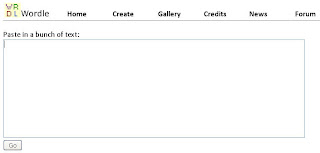
Type your brainstormed words & phrases (from yesterday's blog post) into the big box and then click the button underneath it that says "Go." Give the website a minute or so to load. (It will take some time for the image to come up, but that's ok!) Once the image loads, scroll down & look below it. There will be a button near the bottom right corner that says "Save to public gallery." Click that and then give your picture a title. For the user name, type in just your first name, and then click "Ok." When your image comes up next, look up top in the address bar of your browser. That's the web address of your image!
Let's see what you come up with in Wordle! Highlight that web address, go up to the "Edit" menu of your browser, click on that, and go to "Copy." Then, come back to this blog, reply to the topic, and paste your web address in the box. (To paste it, click in the blog box like you're going to type in a reply, go up to "Edit," and then go to "Paste.")
Want to see what I did using Wordle? Click here: http://www.wordle.net/gallery/wrdl/732584/GED_Online
We're going to experiment with a website called Wordle (http://www.wordle.net/create). Go to that website by clicking the link. Once there, you'll see a screen like the image shown below.

Type your brainstormed words & phrases (from yesterday's blog post) into the big box and then click the button underneath it that says "Go." Give the website a minute or so to load. (It will take some time for the image to come up, but that's ok!) Once the image loads, scroll down & look below it. There will be a button near the bottom right corner that says "Save to public gallery." Click that and then give your picture a title. For the user name, type in just your first name, and then click "Ok." When your image comes up next, look up top in the address bar of your browser. That's the web address of your image!
Let's see what you come up with in Wordle! Highlight that web address, go up to the "Edit" menu of your browser, click on that, and go to "Copy." Then, come back to this blog, reply to the topic, and paste your web address in the box. (To paste it, click in the blog box like you're going to type in a reply, go up to "Edit," and then go to "Paste.")
Want to see what I did using Wordle? Click here: http://www.wordle.net/gallery/wrdl/732584/GED_Online
Wednesday, April 8, 2009
Writing - Brainstorming (Part 2)
Let's take a detour from the vocabulary studies & have some fun with something else. (Vocabulary is fun, right?) I'd like you to brainstorm some words or short phrases that come to mind when you think of your online class.
Make a short list below with 3-6 items. It can be anything that comes to mind when you think of your online class: subjects you study, technology you use, skills you've learned, etc.
:-)
Make a short list below with 3-6 items. It can be anything that comes to mind when you think of your online class: subjects you study, technology you use, skills you've learned, etc.
:-)
Tuesday, April 7, 2009
Vocabulary - Use It Or Lose It (Part 24)
Our April exploration of vocabulary (at least for this word list) is quickly coming to an end. Look at this next set of words.
Which 2-3 words did you already know or have you seen before in writing? Post those words and their definitions. Which 2-3 words were you least familiar with? Post those words with their definitions. Then try using each of those words in a correctly written sentence to show that you now know the word!
| revocation | cancellation; withdrawal |
| scan | to look closely but quickly |
| strand | a beach; to abandon; thread |
| strife | fighting; struggle |
| topple | fall down |
| acute | with a sharp point; keen and alert |
| bluster | rant, talk in a threatening way |
| bungle | blunder; work clumsily |
| commentary | explanation |
| duration | the length of time that something lasts |
| eerie | causing fear; frightening |
| facet | characteristic |
| fidelity | loyalty |
| fray | a brawl, noisy quarrel, unravel |
| headstrong | willful; stubborn |
Which 2-3 words did you already know or have you seen before in writing? Post those words and their definitions. Which 2-3 words were you least familiar with? Post those words with their definitions. Then try using each of those words in a correctly written sentence to show that you now know the word!
Monday, April 6, 2009
Vocabulary - Use It Or Lose It (Part 23)
More vocabulary is here! (Don't you just love it?!)
Which 2-3 words do you think you could use the most in your writing & speaking? Post those words with their definitions. Then use 1 of them in a correctly written sentence.
| acquit | to be found innocent |
| deem | to think or believe |
| devastate | to destroy; wreck |
| discredit | to damage a reputation |
| elusive | hard to understand or catch |
| generate | to start; create |
| idolize | to worship as a god; adore |
| ingratitude | lack of thankfulness |
| keepsake | souvenir |
| mortal | a being that eventually will die; human |
| ovation | applause; cheers |
| petty | unimportant |
| plight | a sad condition |
| repent | to feel sorry for something you did; regret |
| reverie | daydream |
Which 2-3 words do you think you could use the most in your writing & speaking? Post those words with their definitions. Then use 1 of them in a correctly written sentence.
Sunday, April 5, 2009
Vocabulary - Use It Or Lose It (Part 22)
Get ready for more great vocabulary terms!
Today, identify 2-3 words from that list that you knew. Show that you know 1 of those word by correctly using it in a sentence. After that, identify 2-3 words that you didn't know (or didn't know well) before this activity. Post each word with its definition. Then write individual sentences to correctly use each of those words. You can do it!!!
| gloat | look at with great satisfaction |
| global | worldwide |
| illusion | deception, false idea |
| infuriate | to make very angry |
| motivate | encourage |
| pacifist | peacemaker |
| queue | line of people |
| restrict | hold back |
| sage | wise |
| slake | to satisfy, quench thirst |
| terrain | the landscape |
| vocation | career |
| vow | word of honor |
| waylay | entrap, ambush |
| wither | shrivel, dry up |
Today, identify 2-3 words from that list that you knew. Show that you know 1 of those word by correctly using it in a sentence. After that, identify 2-3 words that you didn't know (or didn't know well) before this activity. Post each word with its definition. Then write individual sentences to correctly use each of those words. You can do it!!!
Saturday, April 4, 2009
Vocabulary - Use It Or Lose It (Part 21)
Let's continue on with our quest for good vocabulary skills! Look at this next set of words.
Please pick out 1-2 words that you're most comfortable with and post those words with definitions. Then pick out 2-3 words that you don't know (or don't know that well) and post those words with definitions. Try correctly using at least 2 of those words in separate sentences.
| groundless | without any good reason or cause |
| hypocrite | phony person |
| incomprehensible | impossible to understand |
| manipulate | to handle or use skillfully |
| maximum | largest amount possible |
| mimic | copycat |
| ruffle | to wrinkle |
| serene | peaceful, calm |
| sheepish | embarrassed |
| stamina | endurance, staying power |
| barrage | bombardment |
| bigot | racist |
| designate | choose, point out |
| diversity | dissimilarity |
| enigma | riddle, mystery |
Please pick out 1-2 words that you're most comfortable with and post those words with definitions. Then pick out 2-3 words that you don't know (or don't know that well) and post those words with definitions. Try correctly using at least 2 of those words in separate sentences.
Friday, April 3, 2009
Vocabulary - Use It Or Lose It (Part 20)
Here's another set of vocabulary words that are important to know & be able to use correctly.
Which 1-2 words did you already know quite well? Post those words & definitions. Which 2-3 words did you not know too well? Post those words with the definitions & then write a sentence correctly using each one.
| libel | a statement that unfairly harms the reputation |
| misgiving | worry, doubt |
| oaf | a stupid person |
| recede | retreat, back up |
| repast | a meal, food |
| adverse | unfavorable, negative |
| arid | extremely dry |
| assailant | attacker |
| billow | a large wave, to rise |
| confront | to meet face-to face |
| constrain | to force, hold back |
| contemporary | present-day |
| depict | to portray, to represent |
| disinterested | impartial, fair minded |
| encompass | surround |
Which 1-2 words did you already know quite well? Post those words & definitions. Which 2-3 words did you not know too well? Post those words with the definitions & then write a sentence correctly using each one.
Thursday, April 2, 2009
Vocabulary - Use It Or Lose It (Part 19)
Look at this next set of vocabulary terms (with meanings).
Which 1 or 2 words did you already know? Which 2-3 words did you not know that well (prior to this activity)? Please post those words with their meanings. Then, challenge yourself to use one of them in a correctly written sentence!
| A | B |
|---|---|
| apparel | clothing |
| beseige | blockade |
| compress | shrink |
| denounce | to condemn openly |
| dispatch | report, kill |
| douse | soak |
| expressly | plainly |
| famished | starving |
| forsake | to give up, to leave |
| gainful | profitable |
| immense | very large or great |
| inept | totally without skill |
| ingenious | imaginative |
| instantaneous | done in an instant |
| irk | to annoy |
Which 1 or 2 words did you already know? Which 2-3 words did you not know that well (prior to this activity)? Please post those words with their meanings. Then, challenge yourself to use one of them in a correctly written sentence!
Wednesday, April 1, 2009
Writing - Happy April Fools' Day
Today, April 1st, is commonly known as April Fools' Day. (Writing connection: Do you see the apostrophe used with the word "Fools" in the name? That means it is a day that belongs to the fools!)
Want to know more about this day? Read the information below (from this Wikipedia page).
April Fools' Day or All Fools' Day, although not a holiday in its own right, is a notable day celebrated in many countries on April 1. The day is marked by the commission of hoaxes and other practical jokes of varying sophistication on friends, family members, enemies, and neighbors, or sending them on fool's errand, the aim of which is to embarrass the gullible. Traditionally, in some countries, the jokes only last until noon: like UK, Australia, New Zealand and Canada, someone who plays a trick after noon is called an "April Fool".[1] Elsewhere, such as in Ireland, France, and the USA, the jokes last all day. Another origin is that April 1 was counted the first day of the year in France. When King Charles IX changed that to January 1, some people stayed with April 1. Those who did were called "April Fools" and were taunted by their neighbors.
Did you participate in any pranks or jokes for today? Please correctly write 1-2 sentences telling us what you did (or didn't) do.
Want to know more about this day? Read the information below (from this Wikipedia page).
April Fools' Day or All Fools' Day, although not a holiday in its own right, is a notable day celebrated in many countries on April 1. The day is marked by the commission of hoaxes and other practical jokes of varying sophistication on friends, family members, enemies, and neighbors, or sending them on fool's errand, the aim of which is to embarrass the gullible. Traditionally, in some countries, the jokes only last until noon: like UK, Australia, New Zealand and Canada, someone who plays a trick after noon is called an "April Fool".[1] Elsewhere, such as in Ireland, France, and the USA, the jokes last all day. Another origin is that April 1 was counted the first day of the year in France. When King Charles IX changed that to January 1, some people stayed with April 1. Those who did were called "April Fools" and were taunted by their neighbors.
Did you participate in any pranks or jokes for today? Please correctly write 1-2 sentences telling us what you did (or didn't) do.
Tuesday, March 31, 2009
Vocabulary - Use It Or Lose It (Part 18)
Check out these vocabulary words. Which one or ones do you know? Which one or ones don't you know? Please post 1-2 words (with the meanings) that you know and 1-2 words (with the meanings) that you didn't know (prior to this blog entry).
(Words from http://www.quia.com/jg/527603list.html.)
| A | B |
|---|---|
| berate | "to criticize or scold harshly." |
| estrange | "to drive away or alienate." |
| euphoric | "very happy, overjoyed." |
| impetuous | "impulsive, done in a hurry." |
| infallible | "perfect,unable to make a mistake." |
| maudlin | "overly emotional,tearfully sentimental." |
| regress | "to go backward,to return to a worse condition." |
| relinquish | "to yield or surrender." |
| ubiquitous | "found or existing everywhere" |
| zenith | "the highest point, the peak." |
(Words from http://www.quia.com/jg/527603list.html.)
Monday, March 30, 2009
Tell me a story - March's edition
Before March is over, let's have some fun with writing! The Monday (March 23rd) blog topic dealt with brainstorming some terms that you think of when you hear "spring." (To participate in that topic, click here.)
Use those brainstorming terms & develop a short (3-6 sentence) story. Please share your brainstorming terms before you write your story. (If already participated in the brainstorming, but can't recall what you used, click here.)
I'll start!
My terms were warmer weather, greener grass, rain storms, flowers.
The warmer weather had arrived to Tracy's neighborhood. There was greener grass all over and kids were outside playing every day. Only when rain storms arrived did the children go inside to play. Every yard had colorful pink, yellow, and purple flowers outside. What a beautiful site it was!
Now you go!
Use those brainstorming terms & develop a short (3-6 sentence) story. Please share your brainstorming terms before you write your story. (If already participated in the brainstorming, but can't recall what you used, click here.)
I'll start!
My terms were warmer weather, greener grass, rain storms, flowers.
The warmer weather had arrived to Tracy's neighborhood. There was greener grass all over and kids were outside playing every day. Only when rain storms arrived did the children go inside to play. Every yard had colorful pink, yellow, and purple flowers outside. What a beautiful site it was!
Now you go!
Friday, March 27, 2009
Vocabulary - Technology Terms (Part 3)
Here's the third and final part of vocabulary terms from http://www.tekmom.com/buzzwords/. Check out this list. Find one word that you're very familiar with and check to make sure that the meaning of the word shown on the site is the same as the meaning you think it has. Then, find the word that you're most unfamiliar with, click on it to view the meaning, and post that word with the meaning on the blog. Want an extra challenge? See if you can correctly use that word in a sentence!
monitor
network
peripheral
pixel
processor (micro-)
RAM
RAM vs. Hard Disk
record
scanner
software
spreadsheet
URL
USB
virus
World Wide Web (or Web)
Thursday, March 26, 2009
Vocabulary - Technology Terms (Part 2)
Here's the next set of technology terms (from http://www.tekmom.com/buzzwords/) to review. Just like before, please look for 2 or 3 words that you aren't familiar with, click on each word, and look at the definition. Then come back & post what you learned!
download
e-mail
field
floppy disk (diskette)
gigabyte (GB)
hard disk/hard drive
hardware
HTML
icon
initialize
Internet
kilobyte (K)
megabyte (MB)
memory
modem
Wednesday, March 25, 2009
Vocabulary - Technology Terms (Part 1)
There's a great website that I found (http://www.tekmom.com/buzzwords/) that has important technology words that everyone should know. This blog post & the next two will focus on these words.
Take a look at the first set (shown below). Which 2 or 3 words don't you know (or don't you know that well)? Click on each of those words to see a definition. Then, come back to this blog and report the words you looked up and each one's definition.
Take a look at the first set (shown below). Which 2 or 3 words don't you know (or don't you know that well)? Click on each of those words to see a definition. Then, come back to this blog and report the words you looked up and each one's definition.
backup
binary
bit
browser
byte
cable
CD-ROM
cell
chat
chip (integr. circuit)
computer
CPU
cursor
database
disk drive
Tuesday, March 24, 2009
Writing - Turning Your Brainstorming Into More!
The last blog post asked you to do some brainstorming on things that came to mind when you thought of the season of "spring." I'd like you to make sure that you participated on that topic and then, once you've done that, think about one of your brainstorming ideas. Turn that into a sentence or two where you're giving more detail about that item.
I'll start!
Brainstorming: warmer weather
Sentences: The spring brings warmer weather. Instead of having cold fronts that bring chilly air, you can count on spring having comfortable temperatures that range from 75 to 80 degrees. What a nice time of year it is to be outside!
Now you try!
I'll start!
Brainstorming: warmer weather
Sentences: The spring brings warmer weather. Instead of having cold fronts that bring chilly air, you can count on spring having comfortable temperatures that range from 75 to 80 degrees. What a nice time of year it is to be outside!
Now you try!
Monday, March 23, 2009
Writing - Brainstorming
Any good writing has some planning, pre-writing, and/or brainstorming that happens before the actual writing starts. Did you know that this part of the writing process only needs a few minutes and can be as short as just some words & phrases?
Let's practice this now! Brainstorm some words or phrases that come to mind when you think of the season of spring. (Note: there's no right or wrong answers when doing brainstorming!)
Here are a few things that come to mind for me. Your list may be similar or different!
warmer weather
greener grass
rain storms
flowers
Now let's see your brainstorming list for some spring terms.
Let's practice this now! Brainstorm some words or phrases that come to mind when you think of the season of spring. (Note: there's no right or wrong answers when doing brainstorming!)
Here are a few things that come to mind for me. Your list may be similar or different!
warmer weather
greener grass
rain storms
flowers
Now let's see your brainstorming list for some spring terms.
Saturday, March 21, 2009
Writing - Proper Nouns
I'm sure you remember learning that nouns could be a person, place, or a thing. Nouns can also be singular or plural. But, in general, nouns don't get capitalized unless they are the first word of a sentence. Why do other nouns, like "Bank of America," get capitalized no matter where they are in the sentence? That's because it's a proper noun is the specific name of a person, place, or a thing. Let's look a few examples.
Noun: country
Proper noun: Canada
Noun: city
Proper noun: Hollywood
Noun: teacher
Proper noun: Mrs. Jones
Noun: police officer
Proper noun: Captain Harold Cornwall
Noun: soda
Proper noun: Pepsi
Noun: company
Proper noun: Sony
Now it's your turn. Please write two sentences. One sentence should use a regular (general) noun; the next sentence should use a proper noun representing that same thing. An example is below.
I bought the newspaper at the store. The Sun-Sentinel is my favorite publication.
(My regular noun was "newspaper" and my proper noun was "Sun-Sentinel," which is the name of a specific newspaper.)
Noun: country
Proper noun: Canada
Noun: city
Proper noun: Hollywood
Noun: teacher
Proper noun: Mrs. Jones
Noun: police officer
Proper noun: Captain Harold Cornwall
Noun: soda
Proper noun: Pepsi
Noun: company
Proper noun: Sony
Now it's your turn. Please write two sentences. One sentence should use a regular (general) noun; the next sentence should use a proper noun representing that same thing. An example is below.
I bought the newspaper at the store. The Sun-Sentinel is my favorite publication.
(My regular noun was "newspaper" and my proper noun was "Sun-Sentinel," which is the name of a specific newspaper.)
Wednesday, March 18, 2009
Business Vocabulary (Part 3)
With any discussion of business, it's important to include mention of money. Our next set of business vocabulary terms will relate to money! (Who doesn't love that?!)
Visit this link (http://www.englishclub.com/business-english/vocabulary_money.htm). Find 1-2 terms that you don't know (or don't know well) and post the words with their definitions. Can you then write one sentence that incorporates both of those words used correctly? Give it a try!
Visit this link (http://www.englishclub.com/business-english/vocabulary_money.htm). Find 1-2 terms that you don't know (or don't know well) and post the words with their definitions. Can you then write one sentence that incorporates both of those words used correctly? Give it a try!
Tuesday, March 17, 2009
Business Vocabulary (Part 2)
Next, let's explore some business vocabulary related to meetings. (At some point it seems like we're all in a meeting or hearing about a meeting that happened!)
Visit this link (http://www.englishclub.com/business-english/vocabulary_meetings.htm). Pick 2 or 3 terms that you're not familiar with and post them to this blog. Be sure to review what others have posted too!
Visit this link (http://www.englishclub.com/business-english/vocabulary_meetings.htm). Pick 2 or 3 terms that you're not familiar with and post them to this blog. Be sure to review what others have posted too!
Monday, March 16, 2009
Business Vocabulary (Part 1)
With so much emphasis today on the economy and the job market, let's spend some time looking over some important business vocabulary terms that relate to employment.
Visit this link (http://www.englishclub.com/business-english/vocabulary_employment.htm). Find 2-3 terms that you're not totally familiar with and come back to this blog so you can post the words & definitions of each. Then try to use one of those words correctly in a sentence.
Visit this link (http://www.englishclub.com/business-english/vocabulary_employment.htm). Find 2-3 terms that you're not totally familiar with and come back to this blog so you can post the words & definitions of each. Then try to use one of those words correctly in a sentence.
Thursday, March 12, 2009
Business Writing - Know Your Audience (Part 2)
Did the last blog topic get you thinking about what might need to be done differently if your audience is not a North American company or business person? Let's take a look at what protocols should be followed if you have a Chinese business audience. (Did you know that China is one of the fastest growing business markets in the world?)
This website link (for Perdue's OWL site) will focus on two areas:
http://owl.english.purdue.edu/owl/resource/676/01/
Review the various topics covered. Then come back here & write a few sentences about what you found to be the most different from what you're used to seeing or doing with North American business writing.
This website link (for Perdue's OWL site) will focus on two areas:
- Letters and Memos
- Style considerations
http://owl.english.purdue.edu/owl/resource/676/01/
Review the various topics covered. Then come back here & write a few sentences about what you found to be the most different from what you're used to seeing or doing with North American business writing.
Wednesday, March 11, 2009
Business Writing - Know Your Audience (Part 1)
The Online Writing Lab (sometimes referred to as "OWL") at Perdue University has some excellent writing resources, including the next few sites that this blog will use.
In any type of writing, it's important to know who your audience is and what they are looking for in your writing. Let's take a look at some tips when doing business writing for a North American audience. (Recall that North America comprises Canada, the U.S., and Mexico.)
The topics covered will include:
http://owl.english.purdue.edu/owl/resource/651/01/
In any type of writing, it's important to know who your audience is and what they are looking for in your writing. Let's take a look at some tips when doing business writing for a North American audience. (Recall that North America comprises Canada, the U.S., and Mexico.)
The topics covered will include:
- Getting to the point
- Keeping it simple
- Using passive and active voice
- Using nondiscriminatory language
- Over-generalizing verbs
http://owl.english.purdue.edu/owl/resource/651/01/
Tuesday, March 10, 2009
Writing - Business Expressions (Part 2)
The previous blog post let you check out 20 common business idioms. How about a look at another set of 20 to see which ones you know & which ones you don't know?
Check out this site: http://www.teacherjoe.us/BusinessExpressions02.html.
Please review that list, post the 2 idioms that you're least familiar with, and include the meaning of each.
Check out this site: http://www.teacherjoe.us/BusinessExpressions02.html.
Please review that list, post the 2 idioms that you're least familiar with, and include the meaning of each.
Monday, March 9, 2009
Writing - Business Expressions (Part 1)
There are some common business expressions that you may hear (or read or write). Do you know what they mean? Like some other idioms that we've explored, they mean something different than if you tried to literally interpret them.
http://www.teacherjoe.us/BusinessExpressions01.html
Check out the 20 business expressions. Pick the 2 that you were least familiar with, come back here, and post the expression with its meaning.
http://www.teacherjoe.us/BusinessExpressions01.html
Check out the 20 business expressions. Pick the 2 that you were least familiar with, come back here, and post the expression with its meaning.
Saturday, March 7, 2009
Writing - 100 Essential Business Verbs
With yesterday's topic being business nouns, it only makes sense that today we'd focus on business verbs! Take a look at this list of 100 essential business verbs by clicking here: http://www.speakspeak.com/html/d2d_english_top_100_verbs_library.htm.
Review the list, pick out two or more verbs that you're not familiar with, and look them up using an online dictionary (such as Dictionary.com or Merriam-Webster.com). Then return to the blog and post the words with definitions. Be sure to check this topic often, as other people will be added words and we can all learn by reading what's been added!
Being familiar with common business nouns and verbs will not only help you increase your vocabulary, but will also help you understand business related discussions & writings. Aren't those good things?
Review the list, pick out two or more verbs that you're not familiar with, and look them up using an online dictionary (such as Dictionary.com or Merriam-Webster.com). Then return to the blog and post the words with definitions. Be sure to check this topic often, as other people will be added words and we can all learn by reading what's been added!
Being familiar with common business nouns and verbs will not only help you increase your vocabulary, but will also help you understand business related discussions & writings. Aren't those good things?
Friday, March 6, 2009
Writing - 100 Essential Business Nouns
Let's continue our exploration of business writing.
Today, we'll look at 100 essential business nouns. Visit this site (http://www.speakspeak.com/html/d2e_resources_top_100_nouns_library.htm) and review the list.
Pick out the first 2 or 3 words that you're not familiar with and go look up those terms in an online dictionary, such as Dictionary.com or Merriam-Webster.com. Then, once you've gotten the definitions, please come back here, post each word & its definition.
Be sure to return to this blog topic to see what other students have added after your response. It's a quick way to learn more words and to help others learn new terms too!
Today, we'll look at 100 essential business nouns. Visit this site (http://www.speakspeak.com/html/d2e_resources_top_100_nouns_library.htm) and review the list.
Pick out the first 2 or 3 words that you're not familiar with and go look up those terms in an online dictionary, such as Dictionary.com or Merriam-Webster.com. Then, once you've gotten the definitions, please come back here, post each word & its definition.
Be sure to return to this blog topic to see what other students have added after your response. It's a quick way to learn more words and to help others learn new terms too!
Thursday, March 5, 2009
Writing - Business Letters (Part 2)
Yesterday's blog topic dealt with business letters and various parts that you may see. Hopefully you reviewed those terms & definitions. (If not, visit this link to look over everything before continuing on here with today's topic.)
Test your skills of components of business letters by trying this Quia matching game. Then come back here & write a sentence or two telling us how you did!
Test your skills of components of business letters by trying this Quia matching game. Then come back here & write a sentence or two telling us how you did!
Wednesday, March 4, 2009
Writing - Business Letters
When you write, you've got to know what your purpose is. If you're writing a business letter, there are some components that you're probably going to include. It's just like if you were writing an essay; there are components that must be included with that.
Let's take a look at some common elements on business letters.
(Chart found by clicking here.)
Which item were you most familiar with? Which item, if any, was new to you? Please share those items with us and be sure to include the definition of each one!
Let's take a look at some common elements on business letters.
| A | B |
|---|---|
| Dateline | Displays the date the letter was keyed and mailed. |
| Inside Address | Consists of the receiver's name and title, street address or post office box number, and the city/state/zip code. |
| Salutation | A formal greeting consisting of the receiver's title and last name. |
| Body | The paragraphs of the letter. |
| Complimentary Closing | A formal "goodbye" after the body of the paragraph. |
| Author | The person who wrote the letter. |
| Author's title | The official title of the author. |
| Reference initials | The two or three-letter acronym of the name of the one who typed the letter. |
| Enclosure notation | A note specifying that additional items have been included with the mailing of the letter. |
| Copy notation | A note signifying that another person will receive a copy of the letter. |
| Block style | All items of the business letter begin at the left margin. |
| Modified block style | All items of the business letter begin at the left margin except the date, complimentary closing, and author's name and title, which are keyed begnning at the center point. |
| Open punctuation | Omit the punctuation following the salutation and complimentary closing. |
| Mixed punctuation | Use punctuation after the salutation and complimentary closing. |
Which item were you most familiar with? Which item, if any, was new to you? Please share those items with us and be sure to include the definition of each one!
Subscribe to:
Posts (Atom)