In writing, you can gain a lot by context clues. If you don't know the meaning of a particular word, the other words in that sentence (or paragraph) may help you! I received an email today that perfectly illustrates this! (It also shows that teachers don't know every single word out there!)
Before showing you the email, let me give you a bit of background. I was asked to create some PowerPoint slides for a short presentation that'll be a part of a video conference. I needed these slides (and the information contained on them) to give viewers an idea of what I was going to talk about. I created the slides & sent them in to some "big cheeses." (Isn't that a great idiom?!)
Here's a copy/paste of the email that I received (minus the sender's name).
"Great job at hitting the salient points."
I was not familiar with the word "salient." However, from the context clues in that sentence, I was able to tell that the sender (one of those "big cheeses") was happy with what I did, so I knew the word "salient" couldn't be bad! But, because I didn't know it, I went to an online dictionary site to look it up. Here's what I found!
salient:
Pronunciation: \ˈsā-lyənt, -lē-ənt\
Definitions:
1: moving by leaps or springs
2: jetting upward salient fountain>
3a: projecting beyond a line, surface, or level
3b: standing out conspicuously : prominent; especially : of notable significance
So, based on the context clue in the email of "great" and looking at the definitions of the word, I learned the word (as used in the email I received) was using the final definition (3b).
:-)
Do you use context clues when you read? How much do you think they help you?
Friday, May 29, 2009

Thursday, May 28, 2009
Vocabulary - Use It Or Lose It (Part 26)
In past blog topics called "Vocabulary - Use It Or Lose It," you were typically given a list of terms & then you would pick a few to define. This one will be similar, except I'm going to take an excerpt of an article from the NY Times.
The article is titled "Oxford’s First Female Professor of Poetry Resigns" and can be found here. The topic was not only interesting, but the article had lots of great vocabulary words in it. Here's a bit from the article, with some of those important terms underlined.
"Oxford University's first female Professor of Poetry resigned Monday after acknowledging she had helped publicize charges that her rival for the post had sexually harassed a former student.
Pick one of those words, go to an online dictionary (like Merriam Webster), and look up the definition. Then, come back to this blog, post the word, and the definition. Be sure to review this blog topic & the responses so that we can all learn from each others' replies!
The article is titled "Oxford’s First Female Professor of Poetry Resigns" and can be found here. The topic was not only interesting, but the article had lots of great vocabulary words in it. Here's a bit from the article, with some of those important terms underlined.
"Oxford University's first female Professor of Poetry resigned Monday after acknowledging she had helped publicize charges that her rival for the post had sexually harassed a former student.
Ruth Padel, the great-great-granddaughter of Charles Darwin, made history at Oxford when she became the first woman to be elected to the position of Professor of Poetry since the job was created in 1708.
The five-year post, which is usually awarded to prominent Oxonians, carries few formal responsibilities but packs a lot of prestige: Previous title holders include W. H. Auden and Seamus Heaney.
But Padel's election was marred by Nobel literature laureate Derek Walcott's decision to withdraw as a candidate from the election after anonymous letters attacking him were sent to Oxford academics.
British newspapers reported that the letters made reference to an allegation of sexual harassment made against the St. Lucia-born poet by a former student in the 1980s." (For the rest of the article, click here.)Pick one of those words, go to an online dictionary (like Merriam Webster), and look up the definition. Then, come back to this blog, post the word, and the definition. Be sure to review this blog topic & the responses so that we can all learn from each others' replies!
Wednesday, May 27, 2009
Blogging - Writing vs. Speaking (Part 2)
Did you see the blog topic from May 15th about the audio blog? (To check that out, visit this link: http://elearningbroward.blogspot.com/2009/05/blogging-writing-vs-speaking.html.)
Let's return to Voice Thread to see another example of an audio blog in action & to see how people from all over are participating in it!
Click this link: http://voicethread.com/#q.b1191.i13695 and watch the voice thread. (If you want to participate on the voice thread, either by talking or typing, you will need to join the site. But that is quick & easy to do!)
After reviewing that, try to find some other voice threads that interest you! Go to this site (http://voicethread.com/#home and click the link that says "Browse" (on the top of the page, near the left side). Then, type in any word or phrase you want and press the "Enter" or "Return" key on your keyboard! See what comes up! (Key words like "math," "poetry," "history," and even "blog" bring up lots of neat voice threads!)
Once you've had a chance to do this, come back here & let us know what key word or phrase you used & what type of voice threads you found! Did any seem really good? If so, tell us so we can visit them too! :-)
Let's return to Voice Thread to see another example of an audio blog in action & to see how people from all over are participating in it!
Click this link: http://voicethread.com/#q.b1191.i13695 and watch the voice thread. (If you want to participate on the voice thread, either by talking or typing, you will need to join the site. But that is quick & easy to do!)
After reviewing that, try to find some other voice threads that interest you! Go to this site (http://voicethread.com/#home and click the link that says "Browse" (on the top of the page, near the left side). Then, type in any word or phrase you want and press the "Enter" or "Return" key on your keyboard! See what comes up! (Key words like "math," "poetry," "history," and even "blog" bring up lots of neat voice threads!)
Once you've had a chance to do this, come back here & let us know what key word or phrase you used & what type of voice threads you found! Did any seem really good? If so, tell us so we can visit them too! :-)
Tuesday, May 26, 2009
OperationNice.com
When reading the NY Times online the other day, I saw an article that mentioned the OperationNice.com website. While this blog post won't specifically focus on writing, I think this is worthwhile to post.
The NY Times article gave the following description of OperationNice.com: "OperationNice.com links to news articles about good deeds and asks bloggers to take an oath of niceness. The blog was created 10 months ago by Melissa Morris Ivone, a 28-year-old graphic designer in Cinnaminson, N.J., who was inspired after a stranger held the door for her in an elevator. She wanted to create an oasis of good vibes online.
Today's task is for you to visit the OperationNice.com website and then for you to come back here and tell us what you liked about it. Did you participate on the site? Did you find anything that inspired you? Do tell!
The NY Times article gave the following description of OperationNice.com: "OperationNice.com links to news articles about good deeds and asks bloggers to take an oath of niceness. The blog was created 10 months ago by Melissa Morris Ivone, a 28-year-old graphic designer in Cinnaminson, N.J., who was inspired after a stranger held the door for her in an elevator. She wanted to create an oasis of good vibes online.
“Blogs, message boards and comments sections are just settings for people to verbalize their (usually negative) opinions,” Ms. Ivone wrote in an e-mail message. “Personally, I wanted a little corner that was free of all that.”
Today's task is for you to visit the OperationNice.com website and then for you to come back here and tell us what you liked about it. Did you participate on the site? Did you find anything that inspired you? Do tell!
Monday, May 25, 2009
Always awesome alliteration!
Have you heard the term "alliteration" used before? Even if you haven't, I bet you're familiar with it or could recognize it. Take a look at the sentences & phrases below. Each is an example of alliteration.
Candace creates candy canes.
Stephanie sang so soulfully.
Trent's terrific trees
Always awesome alliteration
Wikipedia defines alliteration as a literary or rhetorical stylistic device that consists in repeating the same consonant sound at the beginning of several words in close succession. An example is the Mother Goose tongue-twister, "Peter Piper picked a peck of pickled peppers …".
Do you want to see some examples of poetry that use alliteration? Visit this link: http://library.thinkquest.org/J0112392/alliterationclassics.html.
Next, come back here & try writing a 2 or 3 word phrase that is an example of alliteration. (If you get stuck, you can "borrow one" from the poems that you see.)
Candace creates candy canes.
Stephanie sang so soulfully.
Trent's terrific trees
Always awesome alliteration
Wikipedia defines alliteration as a literary or rhetorical stylistic device that consists in repeating the same consonant sound at the beginning of several words in close succession. An example is the Mother Goose tongue-twister, "Peter Piper picked a peck of pickled peppers …".
Do you want to see some examples of poetry that use alliteration? Visit this link: http://library.thinkquest.org/J0112392/alliterationclassics.html.
Next, come back here & try writing a 2 or 3 word phrase that is an example of alliteration. (If you get stuck, you can "borrow one" from the poems that you see.)
Tuesday, May 19, 2009
Writing - Let's End Hunger (Part 5)
Do you remember past blog posts about the freerice.com website where you could play vocabulary games and help end hunger? For every question that you answer correctly, the freerice.com website will donate 20 grains of rice through the United Nations' World Food Program to help end hunger. Isn't that wonderful?
I'd like you to visit the site (http://freerice.com/index.php), play at least 3 vocabulary games, and then come back here & post your results. Did you win all 3 games? Did you win 2 of them? Maybe you won 1 of them. Don't worry about the result, but do give it your best shot & see if you can learn something new while helping someone else.
I'd like you to visit the site (http://freerice.com/index.php), play at least 3 vocabulary games, and then come back here & post your results. Did you win all 3 games? Did you win 2 of them? Maybe you won 1 of them. Don't worry about the result, but do give it your best shot & see if you can learn something new while helping someone else.
Monday, May 18, 2009
Paraphrasing
Many times, a boss or supervisor may want you to write a short summary to paraphrase what was said or what happened at an event (like a meeting). Paraphrasing or summarizing means that you're not giving a word-for-word account of what transpired, but that you're giving the most important points or an overview of things.
Let's look at an example.
Perhaps you're at a restaurant and your friend says this to the waiter: "I have some questions about the breakfast specials. Are they all prepared with butter? I'm not sure that I want butter. What about the pancakes? Are they made with butter too? Oh, forget it. I'll just order the waffles and not worry about it."
You might paraphrase that by telling someone that your friend asked some questions about the food, including if it was made with butter, and he decided to order the waffles. (Do you see how that is a much shorter way to give someone the main idea?
I'd like you to give it a try! Visit one of the sites below and pick a story to read. Then, come back here & paraphrase what you read in 2-4 sentences.
Travel Channel
CNN Entertainment
USA Today
Let's look at an example.
Perhaps you're at a restaurant and your friend says this to the waiter: "I have some questions about the breakfast specials. Are they all prepared with butter? I'm not sure that I want butter. What about the pancakes? Are they made with butter too? Oh, forget it. I'll just order the waffles and not worry about it."
You might paraphrase that by telling someone that your friend asked some questions about the food, including if it was made with butter, and he decided to order the waffles. (Do you see how that is a much shorter way to give someone the main idea?
I'd like you to give it a try! Visit one of the sites below and pick a story to read. Then, come back here & paraphrase what you read in 2-4 sentences.
Travel Channel
CNN Entertainment
USA Today
Friday, May 15, 2009
Blogging - Writing vs. Speaking
I don't know about you, but when I think of blogging, I think of writing (or typing). However, I learned about a new website called "Voice Thread" which is a way to do a talking blog.
Visit the Voice Thread link below and watch the short presentation about writing an arg ument essay. If the presentation doesn't automatically start, click the play button (shown to the right of here). Once you've watched it, report back. Did you like the "talking blog" that was Voice Thread?
http://voicethread.com/#q+writing.b240964.i1254955
Visit the Voice Thread link below and watch the short presentation about writing an arg
 ument essay. If the presentation doesn't automatically start, click the play button (shown to the right of here). Once you've watched it, report back. Did you like the "talking blog" that was Voice Thread?
http://voicethread.com/#q+writing.b240964.i1254955
Thursday, May 14, 2009
More Vocabulary?
Do you want to do more vocabulary? Try this link. http://www.sadlier-oxford.com/vocabulary/Choice/Level%20A/Level%20A%20Unit%201/multiplechoice.html.
Report back on how you did!
Report back on how you did!
Wednesday, May 13, 2009
Vocabulary - Word of the Day
The Merriam-Webster website is really great! You can find an online dictionary, thesaurus, Spanish-English translator, and even definitions for medical terms! (To visit the site, click here.)
One of my favorite things at the site is the "word of the day" archive. This lets you see different past words of the day and you can click on any one to view the definition. So let's work on some vocabulary today. Please visit the link below and click on the word listed for any 3 days. Write down each word and definition. Then come back here & report what you found!
http://www.merriam-webster.com/cgi-bin/wodcalendar.pl
I'll start with one that you might already know!
May 13, 2009
calamari: squid used as food
Remember, do that, but for 3 words! :-)
One of my favorite things at the site is the "word of the day" archive. This lets you see different past words of the day and you can click on any one to view the definition. So let's work on some vocabulary today. Please visit the link below and click on the word listed for any 3 days. Write down each word and definition. Then come back here & report what you found!
http://www.merriam-webster.com/cgi-bin/wodcalendar.pl
I'll start with one that you might already know!
May 13, 2009
calamari: squid used as food
Remember, do that, but for 3 words! :-)
Tuesday, May 12, 2009
Writing - When do you capitalize a title for someone?
Have you ever wondered when you should capitalize the title for someone? Sometimes it can be hard to know when it's correct and when you don't need to do that. The following rule comes from the Online Writing Lab (OWL) site.
Capitalize titles preceding names, but not titles that follow names.
Example 1.) She worked as the assistant to Mayor Hanolovi.
Example 2.) I was able to interview Miriam Moss, mayor of Littonville.
Notice that when the title of "mayor" comes before the name (as you see in example 1), it must be capitalized. When that title comes after the name, it does not need to be capitalized. If you're not using a name at all and just using the title, it does not need to be capitalized. An example of that is shown below.
Example 3.) Mr. Brown was interviewed by the principal of the school.
Now you try! Write two sentences that involve a title. Make sure you follow the two rules from the OWL site and write those sentences correctly. Some sample titles to use are below.
officer
pastor
commissioner
mayor
governor
councilman / councilwoman
bailiff
judge
Notice that when the title of "mayor" comes before the name (as you see in example 1), it must be capitalized. When that title comes after the name, it does not need to be capitalized. If you're not using a name at all and just using the title, it does not need to be capitalized. An example of that is shown below.
Example 3.) Mr. Brown was interviewed by the principal of the school.
Now you try! Write two sentences that involve a title. Make sure you follow the two rules from the OWL site and write those sentences correctly. Some sample titles to use are below.
officer
pastor
commissioner
mayor
governor
councilman / councilwoman
bailiff
judge
Monday, May 11, 2009
Tell me a story - May's edition
Let's work on some creative (and fun) writing! For this edition of "tell me a story," I'd like you to compose a short story (4-8 sentences long) and to incorporate the following items: flowers, rain, rabbits, 2 red pens, a laptop computer, and a local park. Remember to write your sentences correctly and be creative! Your stories can be funny, serious, romantic, or just plain odd! It's up to you!
Monday, April 27, 2009
Writing - Subjects & Verbs (Part 5)
Are you ready to test your knowledge of the verb "to be" and see how well you can use it correctly? Try this Quia activity and post your results!
http://www.quia.com/rr/57599.html
http://www.quia.com/rr/57599.html
Saturday, April 25, 2009
Writing - Subjects & Verbs (Part 4)
Here's a fun Quia activity to test your knowledge on some of the most common irregular verbs. Try it & then report back with how you did!
http://www.quia.com/mc/1054976.html
Have fun!
http://www.quia.com/mc/1054976.html
Have fun!
Friday, April 24, 2009
Writing - Subjects & Verbs (Part 3)
Yesterday's blog post dealt with verbs, but more specifically, regular verbs. Recall that regular verbs fall into a "regular" pattern, especially when you think about the present, past, and past participle forms. Below is an example with the verb "dance."
Present tense: I dance all day long.
Past tense: He danced at the wedding last year.
Past participle: They have danced before.
However, irregular verbs don't follow that nice pattern, so they're harder to learn & use correctly. An example of an irregular verb is "sing." Look at the forms below for present, past, and past participle.
Present tense: I sing at choir practice.
Past tense: She sang at the audition.
Past participle: We have sung that song before.
Notice that with an irregular verb, like "sing," the format is changing each time! Plus, if you picked another irregular verb, like "buy," the form would change, but only some of the time! Other irregular verbs, like "cut," have no change at all! Gosh, isn't it tough?
Take a look at this list of irregular verbs by clicking here: http://www.englishclub.com/vocabulary/irregular-verbs-list.htm.
Pick 1 set of irregular verbs & write three sentences where you're illustrating correct use of the present, past, and past participle forms of the verb. Remember that the past participle form will always have a "helper" verb.
Here's an example.
Irregular verb: write
Present tense: I write letters to my family.
Past tense: Last year, I wrote over fifty memos.
Past participle: I have written many poems.
Now you try!
Present tense: I dance all day long.
Past tense: He danced at the wedding last year.
Past participle: They have danced before.
However, irregular verbs don't follow that nice pattern, so they're harder to learn & use correctly. An example of an irregular verb is "sing." Look at the forms below for present, past, and past participle.
Present tense: I sing at choir practice.
Past tense: She sang at the audition.
Past participle: We have sung that song before.
Notice that with an irregular verb, like "sing," the format is changing each time! Plus, if you picked another irregular verb, like "buy," the form would change, but only some of the time! Other irregular verbs, like "cut," have no change at all! Gosh, isn't it tough?
Take a look at this list of irregular verbs by clicking here: http://www.englishclub.com/vocabulary/irregular-verbs-list.htm.
Pick 1 set of irregular verbs & write three sentences where you're illustrating correct use of the present, past, and past participle forms of the verb. Remember that the past participle form will always have a "helper" verb.
Here's an example.
Irregular verb: write
Present tense: I write letters to my family.
Past tense: Last year, I wrote over fifty memos.
Past participle: I have written many poems.
Now you try!
Thursday, April 23, 2009
Writing - Subjects & Verbs (Part 2)
Verbs can be the hardest part of the English language. In fact, conjugating verbs (putting them in the correct forms depending upon what the subject is) can be tough! The verb "to be" can have many conjugated forms including the following: am, is, are, was, were, be, been, has, have, will, shall, etc. Part of what makes this so hard is that it's an "irregular verb" which means it doesn't follow a standard verb format like other "regular" verbs do (such as the verbs "ask," "call," or "dance").
For a list of 600 regular verbs, click here: http://www.englishclub.com/vocabulary/regular-verbs-list.htm.
Pick 1 of those regular verbs and write 5 sentences with it where the subjects are "I," "you," "she," "they," and "we." I'll do an example.
Verb: admire
I admire my cat's ability to sleep anywhere!
You admire your sister's creativity.
She admires her father's intelligence.
They admire people who can cook.
We admire anyone who works hard.
Now you try with a different verb from the list of regular verbs (using the link above).
For a list of 600 regular verbs, click here: http://www.englishclub.com/vocabulary/regular-verbs-list.htm.
Pick 1 of those regular verbs and write 5 sentences with it where the subjects are "I," "you," "she," "they," and "we." I'll do an example.
Verb: admire
I admire my cat's ability to sleep anywhere!
You admire your sister's creativity.
She admires her father's intelligence.
They admire people who can cook.
We admire anyone who works hard.
Now you try with a different verb from the list of regular verbs (using the link above).
Wednesday, April 22, 2009
Back to Blogging!
Gosh, it's been a while since there was a new blog topic. (I apologize about that!) Actually, part of what kept me away was a GED conference. However, I came away with some great ideas on things that I can use as blog topics.
Did you know that one of the most missed language arts questions on the GED test deals with subject-verb agreement? Problems with subject-verb agreement can impact you negatively on both the multiple choice section and the actual essay part. Don't let something give you double deductions!
Try this short Quia game & see how you do on some questions for subject-verb agreement. Then come back here & post your results. After that, write 2 more sentences telling me if you feel comfortable with this topic. Be sure you have correct subject-verb agreement in your sentences!
Quia game link: http://www.quia.com/pop/38406.html
Did you know that one of the most missed language arts questions on the GED test deals with subject-verb agreement? Problems with subject-verb agreement can impact you negatively on both the multiple choice section and the actual essay part. Don't let something give you double deductions!
Try this short Quia game & see how you do on some questions for subject-verb agreement. Then come back here & post your results. After that, write 2 more sentences telling me if you feel comfortable with this topic. Be sure you have correct subject-verb agreement in your sentences!
Quia game link: http://www.quia.com/pop/38406.html
Tuesday, April 14, 2009
Tell me a story - April's edition
April 15th will be "tax day" when income tax returns are due. In a strange "celebration" of this, let's have April's "tell me a story" blog topic. I'll give you a portion of a sentence to start with and then you can take that in any direction. Please finish up the sentence and add 3-6 correctly written sentences to help create your story. Have fun with it!
Maria called her tax account and was flabbergasted when he said . . .
Maria called her tax account and was flabbergasted when he said . . .
Monday, April 13, 2009
Vocabulary - Use It Or Lose It (Part 25)
Here's the last installment of the Quia vocabulary list. Are you ready to learn more important words? Take a look at what's below.
Which 2-3 words did you already know? Post those words with their definitions.
Which 2-3 words did you not know (or not know too well)? Post those words with their definitions.
Which 1 word do you think you could use the most in your writing or speaking? Post that word, its definition, and then use it in a sentence.
| inhabitant | resident |
| numb | unfeeling |
| pacify | to make peaceful or calm; soothe |
| ravenous | starved |
| refute | to prove incorrect |
| remorse | guilt |
| setback | failure |
| smug | conceited |
| synopsis | outline, brief summary |
| tarry | dawdle |
Which 2-3 words did you already know? Post those words with their definitions.
Which 2-3 words did you not know (or not know too well)? Post those words with their definitions.
Which 1 word do you think you could use the most in your writing or speaking? Post that word, its definition, and then use it in a sentence.
Thursday, April 9, 2009
Writing - Brainstorming (Part 3)
Hopefully you participated in yesterday's blog post about brainstorming. (If not, please go to that post by clicking here and then coming back to this blog topic.)
We're going to experiment with a website called Wordle (http://www.wordle.net/create). Go to that website by clicking the link. Once there, you'll see a screen like the image shown below.
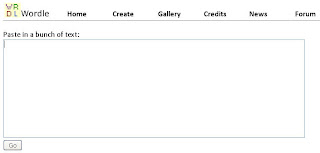
Type your brainstormed words & phrases (from yesterday's blog post) into the big box and then click the button underneath it that says "Go." Give the website a minute or so to load. (It will take some time for the image to come up, but that's ok!) Once the image loads, scroll down & look below it. There will be a button near the bottom right corner that says "Save to public gallery." Click that and then give your picture a title. For the user name, type in just your first name, and then click "Ok." When your image comes up next, look up top in the address bar of your browser. That's the web address of your image!
Let's see what you come up with in Wordle! Highlight that web address, go up to the "Edit" menu of your browser, click on that, and go to "Copy." Then, come back to this blog, reply to the topic, and paste your web address in the box. (To paste it, click in the blog box like you're going to type in a reply, go up to "Edit," and then go to "Paste.")
Want to see what I did using Wordle? Click here: http://www.wordle.net/gallery/wrdl/732584/GED_Online
We're going to experiment with a website called Wordle (http://www.wordle.net/create). Go to that website by clicking the link. Once there, you'll see a screen like the image shown below.

Type your brainstormed words & phrases (from yesterday's blog post) into the big box and then click the button underneath it that says "Go." Give the website a minute or so to load. (It will take some time for the image to come up, but that's ok!) Once the image loads, scroll down & look below it. There will be a button near the bottom right corner that says "Save to public gallery." Click that and then give your picture a title. For the user name, type in just your first name, and then click "Ok." When your image comes up next, look up top in the address bar of your browser. That's the web address of your image!
Let's see what you come up with in Wordle! Highlight that web address, go up to the "Edit" menu of your browser, click on that, and go to "Copy." Then, come back to this blog, reply to the topic, and paste your web address in the box. (To paste it, click in the blog box like you're going to type in a reply, go up to "Edit," and then go to "Paste.")
Want to see what I did using Wordle? Click here: http://www.wordle.net/gallery/wrdl/732584/GED_Online
Wednesday, April 8, 2009
Writing - Brainstorming (Part 2)
Let's take a detour from the vocabulary studies & have some fun with something else. (Vocabulary is fun, right?) I'd like you to brainstorm some words or short phrases that come to mind when you think of your online class.
Make a short list below with 3-6 items. It can be anything that comes to mind when you think of your online class: subjects you study, technology you use, skills you've learned, etc.
:-)
Make a short list below with 3-6 items. It can be anything that comes to mind when you think of your online class: subjects you study, technology you use, skills you've learned, etc.
:-)
Tuesday, April 7, 2009
Vocabulary - Use It Or Lose It (Part 24)
Our April exploration of vocabulary (at least for this word list) is quickly coming to an end. Look at this next set of words.
Which 2-3 words did you already know or have you seen before in writing? Post those words and their definitions. Which 2-3 words were you least familiar with? Post those words with their definitions. Then try using each of those words in a correctly written sentence to show that you now know the word!
| revocation | cancellation; withdrawal |
| scan | to look closely but quickly |
| strand | a beach; to abandon; thread |
| strife | fighting; struggle |
| topple | fall down |
| acute | with a sharp point; keen and alert |
| bluster | rant, talk in a threatening way |
| bungle | blunder; work clumsily |
| commentary | explanation |
| duration | the length of time that something lasts |
| eerie | causing fear; frightening |
| facet | characteristic |
| fidelity | loyalty |
| fray | a brawl, noisy quarrel, unravel |
| headstrong | willful; stubborn |
Which 2-3 words did you already know or have you seen before in writing? Post those words and their definitions. Which 2-3 words were you least familiar with? Post those words with their definitions. Then try using each of those words in a correctly written sentence to show that you now know the word!
Monday, April 6, 2009
Vocabulary - Use It Or Lose It (Part 23)
More vocabulary is here! (Don't you just love it?!)
Which 2-3 words do you think you could use the most in your writing & speaking? Post those words with their definitions. Then use 1 of them in a correctly written sentence.
| acquit | to be found innocent |
| deem | to think or believe |
| devastate | to destroy; wreck |
| discredit | to damage a reputation |
| elusive | hard to understand or catch |
| generate | to start; create |
| idolize | to worship as a god; adore |
| ingratitude | lack of thankfulness |
| keepsake | souvenir |
| mortal | a being that eventually will die; human |
| ovation | applause; cheers |
| petty | unimportant |
| plight | a sad condition |
| repent | to feel sorry for something you did; regret |
| reverie | daydream |
Which 2-3 words do you think you could use the most in your writing & speaking? Post those words with their definitions. Then use 1 of them in a correctly written sentence.
Sunday, April 5, 2009
Vocabulary - Use It Or Lose It (Part 22)
Get ready for more great vocabulary terms!
Today, identify 2-3 words from that list that you knew. Show that you know 1 of those word by correctly using it in a sentence. After that, identify 2-3 words that you didn't know (or didn't know well) before this activity. Post each word with its definition. Then write individual sentences to correctly use each of those words. You can do it!!!
| gloat | look at with great satisfaction |
| global | worldwide |
| illusion | deception, false idea |
| infuriate | to make very angry |
| motivate | encourage |
| pacifist | peacemaker |
| queue | line of people |
| restrict | hold back |
| sage | wise |
| slake | to satisfy, quench thirst |
| terrain | the landscape |
| vocation | career |
| vow | word of honor |
| waylay | entrap, ambush |
| wither | shrivel, dry up |
Today, identify 2-3 words from that list that you knew. Show that you know 1 of those word by correctly using it in a sentence. After that, identify 2-3 words that you didn't know (or didn't know well) before this activity. Post each word with its definition. Then write individual sentences to correctly use each of those words. You can do it!!!
Saturday, April 4, 2009
Vocabulary - Use It Or Lose It (Part 21)
Let's continue on with our quest for good vocabulary skills! Look at this next set of words.
Please pick out 1-2 words that you're most comfortable with and post those words with definitions. Then pick out 2-3 words that you don't know (or don't know that well) and post those words with definitions. Try correctly using at least 2 of those words in separate sentences.
| groundless | without any good reason or cause |
| hypocrite | phony person |
| incomprehensible | impossible to understand |
| manipulate | to handle or use skillfully |
| maximum | largest amount possible |
| mimic | copycat |
| ruffle | to wrinkle |
| serene | peaceful, calm |
| sheepish | embarrassed |
| stamina | endurance, staying power |
| barrage | bombardment |
| bigot | racist |
| designate | choose, point out |
| diversity | dissimilarity |
| enigma | riddle, mystery |
Please pick out 1-2 words that you're most comfortable with and post those words with definitions. Then pick out 2-3 words that you don't know (or don't know that well) and post those words with definitions. Try correctly using at least 2 of those words in separate sentences.
Friday, April 3, 2009
Vocabulary - Use It Or Lose It (Part 20)
Here's another set of vocabulary words that are important to know & be able to use correctly.
Which 1-2 words did you already know quite well? Post those words & definitions. Which 2-3 words did you not know too well? Post those words with the definitions & then write a sentence correctly using each one.
| libel | a statement that unfairly harms the reputation |
| misgiving | worry, doubt |
| oaf | a stupid person |
| recede | retreat, back up |
| repast | a meal, food |
| adverse | unfavorable, negative |
| arid | extremely dry |
| assailant | attacker |
| billow | a large wave, to rise |
| confront | to meet face-to face |
| constrain | to force, hold back |
| contemporary | present-day |
| depict | to portray, to represent |
| disinterested | impartial, fair minded |
| encompass | surround |
Which 1-2 words did you already know quite well? Post those words & definitions. Which 2-3 words did you not know too well? Post those words with the definitions & then write a sentence correctly using each one.
Thursday, April 2, 2009
Vocabulary - Use It Or Lose It (Part 19)
Look at this next set of vocabulary terms (with meanings).
Which 1 or 2 words did you already know? Which 2-3 words did you not know that well (prior to this activity)? Please post those words with their meanings. Then, challenge yourself to use one of them in a correctly written sentence!
| A | B |
|---|---|
| apparel | clothing |
| beseige | blockade |
| compress | shrink |
| denounce | to condemn openly |
| dispatch | report, kill |
| douse | soak |
| expressly | plainly |
| famished | starving |
| forsake | to give up, to leave |
| gainful | profitable |
| immense | very large or great |
| inept | totally without skill |
| ingenious | imaginative |
| instantaneous | done in an instant |
| irk | to annoy |
Which 1 or 2 words did you already know? Which 2-3 words did you not know that well (prior to this activity)? Please post those words with their meanings. Then, challenge yourself to use one of them in a correctly written sentence!
Wednesday, April 1, 2009
Writing - Happy April Fools' Day
Today, April 1st, is commonly known as April Fools' Day. (Writing connection: Do you see the apostrophe used with the word "Fools" in the name? That means it is a day that belongs to the fools!)
Want to know more about this day? Read the information below (from this Wikipedia page).
April Fools' Day or All Fools' Day, although not a holiday in its own right, is a notable day celebrated in many countries on April 1. The day is marked by the commission of hoaxes and other practical jokes of varying sophistication on friends, family members, enemies, and neighbors, or sending them on fool's errand, the aim of which is to embarrass the gullible. Traditionally, in some countries, the jokes only last until noon: like UK, Australia, New Zealand and Canada, someone who plays a trick after noon is called an "April Fool".[1] Elsewhere, such as in Ireland, France, and the USA, the jokes last all day. Another origin is that April 1 was counted the first day of the year in France. When King Charles IX changed that to January 1, some people stayed with April 1. Those who did were called "April Fools" and were taunted by their neighbors.
Did you participate in any pranks or jokes for today? Please correctly write 1-2 sentences telling us what you did (or didn't) do.
Want to know more about this day? Read the information below (from this Wikipedia page).
April Fools' Day or All Fools' Day, although not a holiday in its own right, is a notable day celebrated in many countries on April 1. The day is marked by the commission of hoaxes and other practical jokes of varying sophistication on friends, family members, enemies, and neighbors, or sending them on fool's errand, the aim of which is to embarrass the gullible. Traditionally, in some countries, the jokes only last until noon: like UK, Australia, New Zealand and Canada, someone who plays a trick after noon is called an "April Fool".[1] Elsewhere, such as in Ireland, France, and the USA, the jokes last all day. Another origin is that April 1 was counted the first day of the year in France. When King Charles IX changed that to January 1, some people stayed with April 1. Those who did were called "April Fools" and were taunted by their neighbors.
Did you participate in any pranks or jokes for today? Please correctly write 1-2 sentences telling us what you did (or didn't) do.
Tuesday, March 31, 2009
Vocabulary - Use It Or Lose It (Part 18)
Check out these vocabulary words. Which one or ones do you know? Which one or ones don't you know? Please post 1-2 words (with the meanings) that you know and 1-2 words (with the meanings) that you didn't know (prior to this blog entry).
(Words from http://www.quia.com/jg/527603list.html.)
| A | B |
|---|---|
| berate | "to criticize or scold harshly." |
| estrange | "to drive away or alienate." |
| euphoric | "very happy, overjoyed." |
| impetuous | "impulsive, done in a hurry." |
| infallible | "perfect,unable to make a mistake." |
| maudlin | "overly emotional,tearfully sentimental." |
| regress | "to go backward,to return to a worse condition." |
| relinquish | "to yield or surrender." |
| ubiquitous | "found or existing everywhere" |
| zenith | "the highest point, the peak." |
(Words from http://www.quia.com/jg/527603list.html.)
Monday, March 30, 2009
Tell me a story - March's edition
Before March is over, let's have some fun with writing! The Monday (March 23rd) blog topic dealt with brainstorming some terms that you think of when you hear "spring." (To participate in that topic, click here.)
Use those brainstorming terms & develop a short (3-6 sentence) story. Please share your brainstorming terms before you write your story. (If already participated in the brainstorming, but can't recall what you used, click here.)
I'll start!
My terms were warmer weather, greener grass, rain storms, flowers.
The warmer weather had arrived to Tracy's neighborhood. There was greener grass all over and kids were outside playing every day. Only when rain storms arrived did the children go inside to play. Every yard had colorful pink, yellow, and purple flowers outside. What a beautiful site it was!
Now you go!
Use those brainstorming terms & develop a short (3-6 sentence) story. Please share your brainstorming terms before you write your story. (If already participated in the brainstorming, but can't recall what you used, click here.)
I'll start!
My terms were warmer weather, greener grass, rain storms, flowers.
The warmer weather had arrived to Tracy's neighborhood. There was greener grass all over and kids were outside playing every day. Only when rain storms arrived did the children go inside to play. Every yard had colorful pink, yellow, and purple flowers outside. What a beautiful site it was!
Now you go!
Friday, March 27, 2009
Vocabulary - Technology Terms (Part 3)
Here's the third and final part of vocabulary terms from http://www.tekmom.com/buzzwords/. Check out this list. Find one word that you're very familiar with and check to make sure that the meaning of the word shown on the site is the same as the meaning you think it has. Then, find the word that you're most unfamiliar with, click on it to view the meaning, and post that word with the meaning on the blog. Want an extra challenge? See if you can correctly use that word in a sentence!
monitor
network
peripheral
pixel
processor (micro-)
RAM
RAM vs. Hard Disk
record
scanner
software
spreadsheet
URL
USB
virus
World Wide Web (or Web)
Thursday, March 26, 2009
Vocabulary - Technology Terms (Part 2)
Here's the next set of technology terms (from http://www.tekmom.com/buzzwords/) to review. Just like before, please look for 2 or 3 words that you aren't familiar with, click on each word, and look at the definition. Then come back & post what you learned!
download
e-mail
field
floppy disk (diskette)
gigabyte (GB)
hard disk/hard drive
hardware
HTML
icon
initialize
Internet
kilobyte (K)
megabyte (MB)
memory
modem
Wednesday, March 25, 2009
Vocabulary - Technology Terms (Part 1)
There's a great website that I found (http://www.tekmom.com/buzzwords/) that has important technology words that everyone should know. This blog post & the next two will focus on these words.
Take a look at the first set (shown below). Which 2 or 3 words don't you know (or don't you know that well)? Click on each of those words to see a definition. Then, come back to this blog and report the words you looked up and each one's definition.
Take a look at the first set (shown below). Which 2 or 3 words don't you know (or don't you know that well)? Click on each of those words to see a definition. Then, come back to this blog and report the words you looked up and each one's definition.
backup
binary
bit
browser
byte
cable
CD-ROM
cell
chat
chip (integr. circuit)
computer
CPU
cursor
database
disk drive
Tuesday, March 24, 2009
Writing - Turning Your Brainstorming Into More!
The last blog post asked you to do some brainstorming on things that came to mind when you thought of the season of "spring." I'd like you to make sure that you participated on that topic and then, once you've done that, think about one of your brainstorming ideas. Turn that into a sentence or two where you're giving more detail about that item.
I'll start!
Brainstorming: warmer weather
Sentences: The spring brings warmer weather. Instead of having cold fronts that bring chilly air, you can count on spring having comfortable temperatures that range from 75 to 80 degrees. What a nice time of year it is to be outside!
Now you try!
I'll start!
Brainstorming: warmer weather
Sentences: The spring brings warmer weather. Instead of having cold fronts that bring chilly air, you can count on spring having comfortable temperatures that range from 75 to 80 degrees. What a nice time of year it is to be outside!
Now you try!
Monday, March 23, 2009
Writing - Brainstorming
Any good writing has some planning, pre-writing, and/or brainstorming that happens before the actual writing starts. Did you know that this part of the writing process only needs a few minutes and can be as short as just some words & phrases?
Let's practice this now! Brainstorm some words or phrases that come to mind when you think of the season of spring. (Note: there's no right or wrong answers when doing brainstorming!)
Here are a few things that come to mind for me. Your list may be similar or different!
warmer weather
greener grass
rain storms
flowers
Now let's see your brainstorming list for some spring terms.
Let's practice this now! Brainstorm some words or phrases that come to mind when you think of the season of spring. (Note: there's no right or wrong answers when doing brainstorming!)
Here are a few things that come to mind for me. Your list may be similar or different!
warmer weather
greener grass
rain storms
flowers
Now let's see your brainstorming list for some spring terms.
Saturday, March 21, 2009
Writing - Proper Nouns
I'm sure you remember learning that nouns could be a person, place, or a thing. Nouns can also be singular or plural. But, in general, nouns don't get capitalized unless they are the first word of a sentence. Why do other nouns, like "Bank of America," get capitalized no matter where they are in the sentence? That's because it's a proper noun is the specific name of a person, place, or a thing. Let's look a few examples.
Noun: country
Proper noun: Canada
Noun: city
Proper noun: Hollywood
Noun: teacher
Proper noun: Mrs. Jones
Noun: police officer
Proper noun: Captain Harold Cornwall
Noun: soda
Proper noun: Pepsi
Noun: company
Proper noun: Sony
Now it's your turn. Please write two sentences. One sentence should use a regular (general) noun; the next sentence should use a proper noun representing that same thing. An example is below.
I bought the newspaper at the store. The Sun-Sentinel is my favorite publication.
(My regular noun was "newspaper" and my proper noun was "Sun-Sentinel," which is the name of a specific newspaper.)
Noun: country
Proper noun: Canada
Noun: city
Proper noun: Hollywood
Noun: teacher
Proper noun: Mrs. Jones
Noun: police officer
Proper noun: Captain Harold Cornwall
Noun: soda
Proper noun: Pepsi
Noun: company
Proper noun: Sony
Now it's your turn. Please write two sentences. One sentence should use a regular (general) noun; the next sentence should use a proper noun representing that same thing. An example is below.
I bought the newspaper at the store. The Sun-Sentinel is my favorite publication.
(My regular noun was "newspaper" and my proper noun was "Sun-Sentinel," which is the name of a specific newspaper.)
Wednesday, March 18, 2009
Business Vocabulary (Part 3)
With any discussion of business, it's important to include mention of money. Our next set of business vocabulary terms will relate to money! (Who doesn't love that?!)
Visit this link (http://www.englishclub.com/business-english/vocabulary_money.htm). Find 1-2 terms that you don't know (or don't know well) and post the words with their definitions. Can you then write one sentence that incorporates both of those words used correctly? Give it a try!
Visit this link (http://www.englishclub.com/business-english/vocabulary_money.htm). Find 1-2 terms that you don't know (or don't know well) and post the words with their definitions. Can you then write one sentence that incorporates both of those words used correctly? Give it a try!
Tuesday, March 17, 2009
Business Vocabulary (Part 2)
Next, let's explore some business vocabulary related to meetings. (At some point it seems like we're all in a meeting or hearing about a meeting that happened!)
Visit this link (http://www.englishclub.com/business-english/vocabulary_meetings.htm). Pick 2 or 3 terms that you're not familiar with and post them to this blog. Be sure to review what others have posted too!
Visit this link (http://www.englishclub.com/business-english/vocabulary_meetings.htm). Pick 2 or 3 terms that you're not familiar with and post them to this blog. Be sure to review what others have posted too!
Monday, March 16, 2009
Business Vocabulary (Part 1)
With so much emphasis today on the economy and the job market, let's spend some time looking over some important business vocabulary terms that relate to employment.
Visit this link (http://www.englishclub.com/business-english/vocabulary_employment.htm). Find 2-3 terms that you're not totally familiar with and come back to this blog so you can post the words & definitions of each. Then try to use one of those words correctly in a sentence.
Visit this link (http://www.englishclub.com/business-english/vocabulary_employment.htm). Find 2-3 terms that you're not totally familiar with and come back to this blog so you can post the words & definitions of each. Then try to use one of those words correctly in a sentence.
Thursday, March 12, 2009
Business Writing - Know Your Audience (Part 2)
Did the last blog topic get you thinking about what might need to be done differently if your audience is not a North American company or business person? Let's take a look at what protocols should be followed if you have a Chinese business audience. (Did you know that China is one of the fastest growing business markets in the world?)
This website link (for Perdue's OWL site) will focus on two areas:
http://owl.english.purdue.edu/owl/resource/676/01/
Review the various topics covered. Then come back here & write a few sentences about what you found to be the most different from what you're used to seeing or doing with North American business writing.
This website link (for Perdue's OWL site) will focus on two areas:
- Letters and Memos
- Style considerations
http://owl.english.purdue.edu/owl/resource/676/01/
Review the various topics covered. Then come back here & write a few sentences about what you found to be the most different from what you're used to seeing or doing with North American business writing.
Wednesday, March 11, 2009
Business Writing - Know Your Audience (Part 1)
The Online Writing Lab (sometimes referred to as "OWL") at Perdue University has some excellent writing resources, including the next few sites that this blog will use.
In any type of writing, it's important to know who your audience is and what they are looking for in your writing. Let's take a look at some tips when doing business writing for a North American audience. (Recall that North America comprises Canada, the U.S., and Mexico.)
The topics covered will include:
http://owl.english.purdue.edu/owl/resource/651/01/
In any type of writing, it's important to know who your audience is and what they are looking for in your writing. Let's take a look at some tips when doing business writing for a North American audience. (Recall that North America comprises Canada, the U.S., and Mexico.)
The topics covered will include:
- Getting to the point
- Keeping it simple
- Using passive and active voice
- Using nondiscriminatory language
- Over-generalizing verbs
http://owl.english.purdue.edu/owl/resource/651/01/
Tuesday, March 10, 2009
Writing - Business Expressions (Part 2)
The previous blog post let you check out 20 common business idioms. How about a look at another set of 20 to see which ones you know & which ones you don't know?
Check out this site: http://www.teacherjoe.us/BusinessExpressions02.html.
Please review that list, post the 2 idioms that you're least familiar with, and include the meaning of each.
Check out this site: http://www.teacherjoe.us/BusinessExpressions02.html.
Please review that list, post the 2 idioms that you're least familiar with, and include the meaning of each.
Monday, March 9, 2009
Writing - Business Expressions (Part 1)
There are some common business expressions that you may hear (or read or write). Do you know what they mean? Like some other idioms that we've explored, they mean something different than if you tried to literally interpret them.
http://www.teacherjoe.us/BusinessExpressions01.html
Check out the 20 business expressions. Pick the 2 that you were least familiar with, come back here, and post the expression with its meaning.
http://www.teacherjoe.us/BusinessExpressions01.html
Check out the 20 business expressions. Pick the 2 that you were least familiar with, come back here, and post the expression with its meaning.
Saturday, March 7, 2009
Writing - 100 Essential Business Verbs
With yesterday's topic being business nouns, it only makes sense that today we'd focus on business verbs! Take a look at this list of 100 essential business verbs by clicking here: http://www.speakspeak.com/html/d2d_english_top_100_verbs_library.htm.
Review the list, pick out two or more verbs that you're not familiar with, and look them up using an online dictionary (such as Dictionary.com or Merriam-Webster.com). Then return to the blog and post the words with definitions. Be sure to check this topic often, as other people will be added words and we can all learn by reading what's been added!
Being familiar with common business nouns and verbs will not only help you increase your vocabulary, but will also help you understand business related discussions & writings. Aren't those good things?
Review the list, pick out two or more verbs that you're not familiar with, and look them up using an online dictionary (such as Dictionary.com or Merriam-Webster.com). Then return to the blog and post the words with definitions. Be sure to check this topic often, as other people will be added words and we can all learn by reading what's been added!
Being familiar with common business nouns and verbs will not only help you increase your vocabulary, but will also help you understand business related discussions & writings. Aren't those good things?
Friday, March 6, 2009
Writing - 100 Essential Business Nouns
Let's continue our exploration of business writing.
Today, we'll look at 100 essential business nouns. Visit this site (http://www.speakspeak.com/html/d2e_resources_top_100_nouns_library.htm) and review the list.
Pick out the first 2 or 3 words that you're not familiar with and go look up those terms in an online dictionary, such as Dictionary.com or Merriam-Webster.com. Then, once you've gotten the definitions, please come back here, post each word & its definition.
Be sure to return to this blog topic to see what other students have added after your response. It's a quick way to learn more words and to help others learn new terms too!
Today, we'll look at 100 essential business nouns. Visit this site (http://www.speakspeak.com/html/d2e_resources_top_100_nouns_library.htm) and review the list.
Pick out the first 2 or 3 words that you're not familiar with and go look up those terms in an online dictionary, such as Dictionary.com or Merriam-Webster.com. Then, once you've gotten the definitions, please come back here, post each word & its definition.
Be sure to return to this blog topic to see what other students have added after your response. It's a quick way to learn more words and to help others learn new terms too!
Thursday, March 5, 2009
Writing - Business Letters (Part 2)
Yesterday's blog topic dealt with business letters and various parts that you may see. Hopefully you reviewed those terms & definitions. (If not, visit this link to look over everything before continuing on here with today's topic.)
Test your skills of components of business letters by trying this Quia matching game. Then come back here & write a sentence or two telling us how you did!
Test your skills of components of business letters by trying this Quia matching game. Then come back here & write a sentence or two telling us how you did!
Wednesday, March 4, 2009
Writing - Business Letters
When you write, you've got to know what your purpose is. If you're writing a business letter, there are some components that you're probably going to include. It's just like if you were writing an essay; there are components that must be included with that.
Let's take a look at some common elements on business letters.
(Chart found by clicking here.)
Which item were you most familiar with? Which item, if any, was new to you? Please share those items with us and be sure to include the definition of each one!
Let's take a look at some common elements on business letters.
| A | B |
|---|---|
| Dateline | Displays the date the letter was keyed and mailed. |
| Inside Address | Consists of the receiver's name and title, street address or post office box number, and the city/state/zip code. |
| Salutation | A formal greeting consisting of the receiver's title and last name. |
| Body | The paragraphs of the letter. |
| Complimentary Closing | A formal "goodbye" after the body of the paragraph. |
| Author | The person who wrote the letter. |
| Author's title | The official title of the author. |
| Reference initials | The two or three-letter acronym of the name of the one who typed the letter. |
| Enclosure notation | A note specifying that additional items have been included with the mailing of the letter. |
| Copy notation | A note signifying that another person will receive a copy of the letter. |
| Block style | All items of the business letter begin at the left margin. |
| Modified block style | All items of the business letter begin at the left margin except the date, complimentary closing, and author's name and title, which are keyed begnning at the center point. |
| Open punctuation | Omit the punctuation following the salutation and complimentary closing. |
| Mixed punctuation | Use punctuation after the salutation and complimentary closing. |
Which item were you most familiar with? Which item, if any, was new to you? Please share those items with us and be sure to include the definition of each one!
Tuesday, March 3, 2009
Writing - Antonyms (Part 2)
An antonym is the opposite of a word. If I asked you what the antonym was for "cat," I bet you'd say "dog." What's the antonym of "dry?" Most people would say "wet," but of course other words could be acceptable too (such as "moist," and "saturated").
Try this short Quia antonym activity & see how you do.
http://www.quia.com/cm/233263.html
Once you're done, come back here & post your favorite word & antonym set from the activity.
Try this short Quia antonym activity & see how you do.
http://www.quia.com/cm/233263.html
Once you're done, come back here & post your favorite word & antonym set from the activity.
Monday, March 2, 2009
Writing - Commonly Confused Words
Past blog topics have focused on some commonly confused words, in particular, homonyms. Here's a great site that gives a list of these words.
http://www2.actden.com/writ_Den/tips/sentence/confused.htm
Visit that site and look through the list. Then pick the set (or two) that you tend to get most confused. Come back to this blog and tell us those words, as well as the meanings for each. Challenge yourself to correctly use each of those words in a sentence!
http://www2.actden.com/writ_Den/tips/sentence/confused.htm
Visit that site and look through the list. Then pick the set (or two) that you tend to get most confused. Come back to this blog and tell us those words, as well as the meanings for each. Challenge yourself to correctly use each of those words in a sentence!
Saturday, February 28, 2009
Time Management Part II
Earlier this month (February 4) time management was a blog topic. Many of you shared what worked for you in managing time with your family, work and school life. We had some great suggestions! Thank you all for sharing.
Time Management is the ability to reclaim the minutes (or 84,600 seconds) in your day and to make those minutes more productive and not time wasters. Some of the most important steps in managing your time is to set a goal, keep track of wasted time, and avoid interruptions.
Can you share with us one of your current goals (in regards to your school work), something that you consider a time waster (there is no wrong or right answer-just your opinion), and what you do to avoid interruptions when you are working, completing your homework or studying?
Also, if you have some TIME consider viewing a presentation we conducted in July 2008 on time management. Visit our Elluminate workshop review area link below and click on 2008-July.
http://www.elearningbroward.com/html/workshop_review.html
Time Management is the ability to reclaim the minutes (or 84,600 seconds) in your day and to make those minutes more productive and not time wasters. Some of the most important steps in managing your time is to set a goal, keep track of wasted time, and avoid interruptions.
Can you share with us one of your current goals (in regards to your school work), something that you consider a time waster (there is no wrong or right answer-just your opinion), and what you do to avoid interruptions when you are working, completing your homework or studying?
Also, if you have some TIME consider viewing a presentation we conducted in July 2008 on time management. Visit our Elluminate workshop review area link below and click on 2008-July.
http://www.elearningbroward.com/html/workshop_review.html
Tuesday, February 17, 2009
Writing - Complete Sentences
One of the most important parts of good writing is to make sure that you are not writing sentence fragments. Remember that a fragment is sentence that's missing either its subject, its verb, or both. Let's look at three examples of fragments.
Example 1: "Went running for miles."
(In this case, the subject is missing. Who went running for miles?)
Example 2: "My cousin Henry."
(In this case, the verb is missing. What is it about your cousin Henry?)
Example 3: "At the mall."
(In this case, both the subject and the verb are missing. Who was at the mall and what was done there?)
You may hear the word referred to as a "predicate." A complete sentence must have a subject and a predicate (or verb). The subject is who or what the sentence is about. The predicate (or verb) is the action that's happening. Sometimes the verb will seem to not show an action, as is the case if you use the verbs "am," "is," "are," "were," "be," "been," etc.
Look at the predicates (verbs) that are underlined in the sentences below.
Kristen was at the mall today. The stores were all open for customers. She shopped all day.
Now that you've had a chance to review subject & predicates, try your skills at identifying them in this Quia activity. Click this link to play the game. Once you're done, come back to the blog and type 2 complete sentences to tell us if you enjoyed the game and how you did!
Have fun!
Example 1: "Went running for miles."
(In this case, the subject is missing. Who went running for miles?)
Example 2: "My cousin Henry."
(In this case, the verb is missing. What is it about your cousin Henry?)
Example 3: "At the mall."
(In this case, both the subject and the verb are missing. Who was at the mall and what was done there?)
You may hear the word referred to as a "predicate." A complete sentence must have a subject and a predicate (or verb). The subject is who or what the sentence is about. The predicate (or verb) is the action that's happening. Sometimes the verb will seem to not show an action, as is the case if you use the verbs "am," "is," "are," "were," "be," "been," etc.
Look at the predicates (verbs) that are underlined in the sentences below.
Kristen was at the mall today. The stores were all open for customers. She shopped all day.
Now that you've had a chance to review subject & predicates, try your skills at identifying them in this Quia activity. Click this link to play the game. Once you're done, come back to the blog and type 2 complete sentences to tell us if you enjoyed the game and how you did!
Have fun!
Thursday, February 12, 2009
Vocabulary - Computer Terms
The eLearning blog has focused a number of posts on vocabulary. Good writers & speakers have a broad, varied knowledge of different words. Today, let's focus on some basic computer terms, as all online students should understand these words.
Take a look at the list below. Read through the terms. Pick 1 or 2 terms that either don't know or don't know well. Post the term and the definition. Then try to use the term in a sentence.
(Chart found at http://www.quia.com/jg/65620list.html)
Take a look at the list below. Read through the terms. Pick 1 or 2 terms that either don't know or don't know well. Post the term and the definition. Then try to use the term in a sentence.
| A | B |
|---|---|
| Hardware | The physical components of the computer system. |
| Software | The programs or instructions that tell the computer what to do. |
| CPU | The brain of the computer or central processing unit. |
| ROM | The permanent memory that is built in your computer. This is read only. |
| RAM | The computer's working memory, sometimes called random-accessed memory. |
| Megabyte | Approximately a million bytes. |
| Gigabyte | Approximately a billion bytes (or 1,000 megabytes). |
| Input Device | The hardware that is used to pass information into the computer. |
| Output Device | The hardware that receives and dislplays information coming from the computer. |
| Modem | The device that allows your computer to talk to other computers over a telephone line. |
| Monitor | A video or computer display device. |
| Laser Printer | A printer that uses both laser and photographic technology to produce high quality output. |
| Printer | The hardware that provides printed output from the computer. |
| Hard Copy | A printed copy of computer output. |
| Compact Disc | A disc on which a laser has digitally recorded information such as audio, video, or computer data. |
| Hard Disk | A fixed, large-capacity magnetic storage medium for computer data. |
| Floppy Disk | A portable magnetic storage medium for computer data that allows users to randomly access information. |
| Graphical User Interface | The use of graphical symbols instead of text commands to control common computer functions such as copying programs and disks. |
| Icon | A small picture or symbol respresenting a computer hardware function or component. |
| Ink-jet Printer | A type of printer that forms letters on the page by shooting tiny electrically charged droplets of ink. |
Wednesday, February 11, 2009
Tell me a story - February's edition
It's time to have some fun with our writing! Let's put on those creative thinking caps and get ready to spin some tales of happiness, humor, romance, mystery, or misery. We're going to have the February edition of "tell me a story." (To see some past "tell me a story" topics, visit these links: December 1st, November 4th, October 4th, September 27th, August 7th, July 2nd, June 3rd, and May 21st. Feel free to participate in them too!)
For this particular one, let's use Valentine's Day as the theme. In 4-6 sentences, tell me a story that involves the following items: candles, chocolate, a single red rose, and a phone call from Mrs. Hernandez. Remember that your story can go in any direction. It doesn't have to have a traditional romantic Valentine's Day theme. Perhaps you're going to create a short mystery or a humorous tale. It's up to you! No matter what you choose, though, have fun with it, and write those sentences correctly!!!
For this particular one, let's use Valentine's Day as the theme. In 4-6 sentences, tell me a story that involves the following items: candles, chocolate, a single red rose, and a phone call from Mrs. Hernandez. Remember that your story can go in any direction. It doesn't have to have a traditional romantic Valentine's Day theme. Perhaps you're going to create a short mystery or a humorous tale. It's up to you! No matter what you choose, though, have fun with it, and write those sentences correctly!!!
Tuesday, February 10, 2009
Writing - Common Homonyms
The eLearning writing blog has had many topics that focused on homonyms. Recall that a homonym is a word that has the same pronunciation as another word, but is spelled differently and has a different meaning. The words "sent," "scent," and "cent" are examples of homonyms.
How well do you know some common homonyms? Are you ready to challenge yourself with a Quia activity? Test your skills with the words "to," "too," "two," "who's," "whose," "your," and "you're" (among others). Find someone who you can play this game with, as it's more fun to have a partner for the challenge board game.
Play this Quia game, come back here, tell us who you shared the activity with, how you did, and if you learned anything new!
How well do you know some common homonyms? Are you ready to challenge yourself with a Quia activity? Test your skills with the words "to," "too," "two," "who's," "whose," "your," and "you're" (among others). Find someone who you can play this game with, as it's more fun to have a partner for the challenge board game.
Play this Quia game, come back here, tell us who you shared the activity with, how you did, and if you learned anything new!
Monday, February 9, 2009
Writing - Using Contractions (Part 2)
Back in November, there was a blog post that dealt with using some common contractions. Please review that post by clicking here. Recall that contractions are used to write two words as one word and they will always involve an apostrophe.
After you've reviewed the November post, please try this Quia challenge board activity. Find someone else who can play with you. (Ask a relative, friend, or neighbor to play. They'll have fun too!) The challenge board activities are similar to "Jeopardy" and can be played by 1 person or 2 people. Enter the names of the players and click the "Begin 2-player game" button.
Once you've completed that Quia activity, come back to the blog and write a few sentences to state who played the activity with you, who won, and which contractions (if any) you were not familiar with. Try writing your sentences and including 1 or 2 appropriately placed, correctly used contractions!
I'm sure you'll enjoy this!
:-)
After you've reviewed the November post, please try this Quia challenge board activity. Find someone else who can play with you. (Ask a relative, friend, or neighbor to play. They'll have fun too!) The challenge board activities are similar to "Jeopardy" and can be played by 1 person or 2 people. Enter the names of the players and click the "Begin 2-player game" button.
Once you've completed that Quia activity, come back to the blog and write a few sentences to state who played the activity with you, who won, and which contractions (if any) you were not familiar with. Try writing your sentences and including 1 or 2 appropriately placed, correctly used contractions!
I'm sure you'll enjoy this!
:-)
Wednesday, February 4, 2009
Time Management
Imagine that you had a bank that credits your account each morning with $86,400, and carries over no balance from day to day. Every night it deletes whatever part of the balance you failed to use during that day. What would you do with such an account? Most likely you would make certain that you spent every cent every day.
Are you surprised that you had such a bank?
It is the time bank!
Every morning, the bank credits you with 86,400 seconds. Every night it writes off, as lost, whatever you have failed to spend or invest wisely. It will not carry over a balance. It does not allow for an overdraft. Each day, it opens a new account in your name: each night it erases your balance. If you fail to use the day's deposits wisely, the loss is profound. If you can invest about 10 percent of this resource each day, for your online course you will receive major dividends in your teaching and learning stock.
There is no drawing against the "tomorrow". No matter how wonderful your time management skills are, you cannot get more than 86,400 seconds in a day. You must live each day on your daily deposit, and invest it wisely to get from it the utmost in health, happiness and success from your personal and professional life! The clock is ticking. Make the most of each online day as well!
How do you make the most of each online day? Share some of the techniques you use to keep you focused and organized in your class.
Are you surprised that you had such a bank?
It is the time bank!
Every morning, the bank credits you with 86,400 seconds. Every night it writes off, as lost, whatever you have failed to spend or invest wisely. It will not carry over a balance. It does not allow for an overdraft. Each day, it opens a new account in your name: each night it erases your balance. If you fail to use the day's deposits wisely, the loss is profound. If you can invest about 10 percent of this resource each day, for your online course you will receive major dividends in your teaching and learning stock.
There is no drawing against the "tomorrow". No matter how wonderful your time management skills are, you cannot get more than 86,400 seconds in a day. You must live each day on your daily deposit, and invest it wisely to get from it the utmost in health, happiness and success from your personal and professional life! The clock is ticking. Make the most of each online day as well!
How do you make the most of each online day? Share some of the techniques you use to keep you focused and organized in your class.
Tuesday, February 3, 2009
Writing - Prefix Challenge Board
Back in December, there was a series of blog posts about common prefixes and their meanings. (To review those topics, click here.)
Let's bring back our prefix studies with this Quia "challenge board" activity. This is a fun way to test your prefix skills and to learn a few new things. The challenge board is similar to Jeopardy where you can select a category and a point value. It can be played with 1 or 2 players. Fill in your names and then click the appropriate start button (either "Begin 1-player game" or "Begin 2-player game").
After you play the prefix challenge board game, come back here & post how you did. If you learned a new prefix, post that too!
http://www.quia.com/cb/221179.html
Have fun!!!
Let's bring back our prefix studies with this Quia "challenge board" activity. This is a fun way to test your prefix skills and to learn a few new things. The challenge board is similar to Jeopardy where you can select a category and a point value. It can be played with 1 or 2 players. Fill in your names and then click the appropriate start button (either "Begin 1-player game" or "Begin 2-player game").
After you play the prefix challenge board game, come back here & post how you did. If you learned a new prefix, post that too!
http://www.quia.com/cb/221179.html
Have fun!!!
Monday, February 2, 2009
Writing - Varied Word Choice
Could you imagine how boring a piece of writing would be if you used the same term or same phrase over and over? Let's take a look at an example of this so you can see just how bad repetition can be when it comes to your sentences.
My sister's name is Kris. Kris lives in New Jersey. Fort Monmouth is where Kris works. Kris drives a white car. Kris loves to go shopping. I talk to Kris at least three times each week. Either Kris calls me or I call her. Kris is getting married in May.
What word or phrase jumps out at you when you read that paragraph? Well, it isn't too hard to see that the name "Kris" is repeated over & over. (In fact, if this paragraph was read out loud to you, you'd certainly be sick of hearing the name "Kris.")
Grammatically, there's nothing wrong with those sentences. However, it's not too pleasant to read. How could I fix that paragraph so that the name "Kris" isn't used so much? Let's keep the first sentence the same, as it's important to know my sister's name. After that, however, we need to vary it for the reader. Pick a sentence and write it another way so I'm not using the name "Kris." (It wouldn't be bad to leave that name in the paragraph another time or two, but having that name repeated eight times is really too much!!!)
Don't worry about rewriting the whole paragraph. Instead, focus on just one sentence that you could modify.
My sister's name is Kris. Kris lives in New Jersey. Fort Monmouth is where Kris works. Kris drives a white car. Kris loves to go shopping. I talk to Kris at least three times each week. Either Kris calls me or I call her. Kris is getting married in May.
What word or phrase jumps out at you when you read that paragraph? Well, it isn't too hard to see that the name "Kris" is repeated over & over. (In fact, if this paragraph was read out loud to you, you'd certainly be sick of hearing the name "Kris.")
Grammatically, there's nothing wrong with those sentences. However, it's not too pleasant to read. How could I fix that paragraph so that the name "Kris" isn't used so much? Let's keep the first sentence the same, as it's important to know my sister's name. After that, however, we need to vary it for the reader. Pick a sentence and write it another way so I'm not using the name "Kris." (It wouldn't be bad to leave that name in the paragraph another time or two, but having that name repeated eight times is really too much!!!)
Don't worry about rewriting the whole paragraph. Instead, focus on just one sentence that you could modify.
Sunday, February 1, 2009
Writing - Idioms (Part 7)
With today being "Superbowl Sunday," it's only fitting that we now focus on sports idioms. Check out this list of sports-related idioms (http://www.idiomconnection.com/sports.html#A) and find one that you've never heard before. Come back to the blog and post that idiom, as well as its meaning.
Can you use that idiom in a sentence? Give it a shot!
If you want to try something else, give the quiz a whirl! Let us know how you did!
Can you use that idiom in a sentence? Give it a shot!
If you want to try something else, give the quiz a whirl! Let us know how you did!
Monday, January 26, 2009
Writing - Idioms (Part 6)
Our next stop on the "idiom tour" is going to be food idioms. Take a look at this list (http://www.idiomconnection.com/food.html#A) and find an idiom (or two) that you either don't know or don't know too well. Then, come back on here, post the idiom and its meaning. If you want to challenge yourself a bit more, see if you can correctly use that idiom in a sentence.
Tuesday, January 20, 2009
Writing - Idioms (Part 5)
Our next goal is to explore idioms that relate to money. This should be a fun one!
Money idioms: http://www.idiomconnection.com/money.html#B
There are a lot of them there, but it's well worth the time to review each one! Once you do that, try the money idiom quiz (found here: http://www.idiomconnection.com/money.html#BQ).
Come back to the blog, share your favorite money idiom, the meaning of it, and the results of your quiz!
:)
Money idioms: http://www.idiomconnection.com/money.html#B
There are a lot of them there, but it's well worth the time to review each one! Once you do that, try the money idiom quiz (found here: http://www.idiomconnection.com/money.html#BQ).
Come back to the blog, share your favorite money idiom, the meaning of it, and the results of your quiz!
:)
Monday, January 19, 2009
Writing - Idioms (Part 4)
Let's continue our exploration of idioms. The last blog post focused on some medical idioms. This time, we'll focus on idioms dealing with color.
Did you ever hear (or read) that a person's face was "as red as a cherry" after a certain event? That saying implies that a person's face was red, possibly from embarrassment or maybe a severe sunburn. That idiom helps you imagine just how red the person's face it. It may be a bit of an exaggeration, but it certainly helps to convey the point!
Take a look at this list of idioms dealing with color.
http://www.idiomconnection.com/color.html#B
Then, once you've reviewed them, try the quiz to see how well you know them!
http://www.idiomconnection.com/color.html#BQ
Lastly, come back to the blog, write your favorite color idiom, the meaning of it, and tell us how you did on the quiz!!!
Did you ever hear (or read) that a person's face was "as red as a cherry" after a certain event? That saying implies that a person's face was red, possibly from embarrassment or maybe a severe sunburn. That idiom helps you imagine just how red the person's face it. It may be a bit of an exaggeration, but it certainly helps to convey the point!
Take a look at this list of idioms dealing with color.
http://www.idiomconnection.com/color.html#B
Then, once you've reviewed them, try the quiz to see how well you know them!
http://www.idiomconnection.com/color.html#BQ
Lastly, come back to the blog, write your favorite color idiom, the meaning of it, and tell us how you did on the quiz!!!
Saturday, January 17, 2009
Writing - Idioms (Part 3)
Let's continue our exploration on idioms. Use the link below to access a website that talks about some medical idioms. Remember that an idiom is a phrase or saying that is not meant to be interpreted literally.
Have you ever heard the phrase "under the weather" stated by someone? Since that's a pretty common saying, I bet you already know that it means "not feeling well."
After you review the medical idioms on that page, try the short 10-question quiz that follows and check your answers! Then, return to the blog to tell us your favorite medical idiom, what it means, and how you did on the quiz.
Medical idioms: http://www.idiomconnection.com/medical.html#B
Have you ever heard the phrase "under the weather" stated by someone? Since that's a pretty common saying, I bet you already know that it means "not feeling well."
After you review the medical idioms on that page, try the short 10-question quiz that follows and check your answers! Then, return to the blog to tell us your favorite medical idiom, what it means, and how you did on the quiz.
Medical idioms: http://www.idiomconnection.com/medical.html#B
Monday, January 12, 2009
Writing - Idioms (Part 2)
Idioms are one of the hardest parts of the English language. An idiom is a term or phrase whose meaning cannot be deduced from the literal definitions and the arrangement of its parts, but refers instead to a figurative meaning that is known only through common use. (Additional information can be found on the July 29th blog post. Click that link to visit the previous idiom post.)
The phrase "keep your eyes peeled" is an idiom. You couldn't interpret that literally, as your eyes can be "peeled" the way a banana can be. But, figuratively, that means to keep your eyes opened and be on the lookout!
Test your knowledge of some common idioms that you may come across in writing & speaking. Try this Quia activity and then come back here to report which idioms (if any) were new to you and which one you were most familiar with already.
Quia activity: http://www.quia.com/mc/66234.html
The phrase "keep your eyes peeled" is an idiom. You couldn't interpret that literally, as your eyes can be "peeled" the way a banana can be. But, figuratively, that means to keep your eyes opened and be on the lookout!
Test your knowledge of some common idioms that you may come across in writing & speaking. Try this Quia activity and then come back here to report which idioms (if any) were new to you and which one you were most familiar with already.
Quia activity: http://www.quia.com/mc/66234.html
Saturday, January 10, 2009
Writing - Nouns
Any complete sentence will always have two parts to it: a subject and a predicate (or verb). Sentence subjects can use singular or plural nouns. (Recall that a noun is a person, place, or thing.)
Singular subjects talk about one noun. Let's look at an example.
The phone is in the office.
In this case, the singular subject is "phone," as only one phone is being discussed.
Plural subjects talk about two or nouns. Below is an example.
Three phones are in my house.
In this case, the plural subject is "phones." There are multiple phones being referenced in that sentence.
Test your knowledge of the singular and plural forms of some nouns by playing this Quia matching activity. Then come back here & report how you did! Did you learn anything new?
Quia link: http://www.quia.com/mc/67715.html
Have fun!
Singular subjects talk about one noun. Let's look at an example.
The phone is in the office.
In this case, the singular subject is "phone," as only one phone is being discussed.
Plural subjects talk about two or nouns. Below is an example.
Three phones are in my house.
In this case, the plural subject is "phones." There are multiple phones being referenced in that sentence.
Test your knowledge of the singular and plural forms of some nouns by playing this Quia matching activity. Then come back here & report how you did! Did you learn anything new?
Quia link: http://www.quia.com/mc/67715.html
Have fun!
Subscribe to:
Posts (Atom)